Key Takeaways
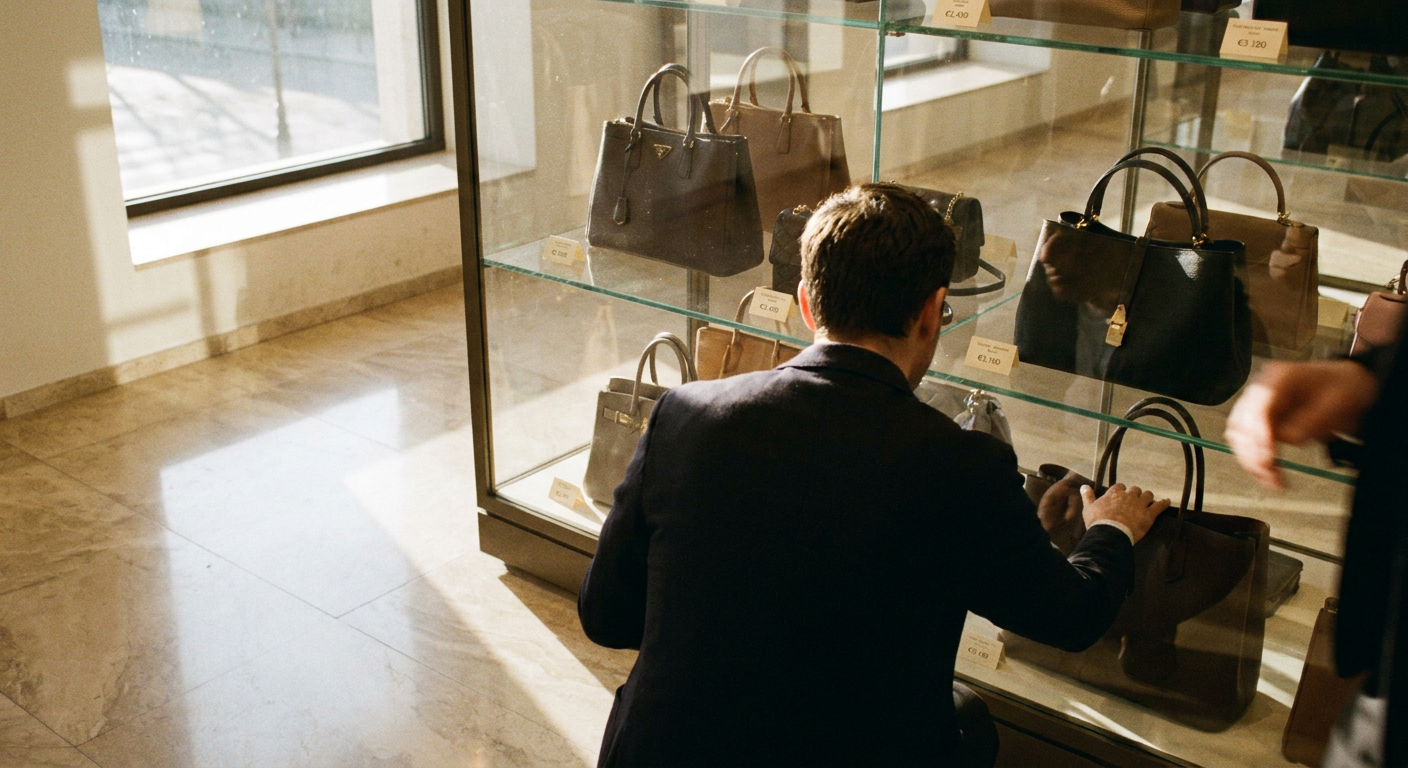
- In luxury handbags, the price is the product itself. Discount it and you signal the item was never worth its original tag, which shrinks sales instead of growing them.
- Premium brands manufacture demand through storytelling, heritage, and waitlists rather than promotions, which lets them defend prices through downturns.
- Prestige pricing triggers the Veblen effect, where affluent buyers read a higher number as proof of quality and status.
- Hermès raised the Birkin roughly 10% to around $11,400, reinforcing its status positioning rather than chasing volume.
- A Chanel Medium Flap now sells for over $10,000, showing how core lines hold firm regardless of the economy.
- Rolex runs the same playbook as luxury handbag makers, using high prices to lock in exclusive positioning.
- A luxury item is defined by being expensive or hard to get, so making it accessible through discounts erodes the core appeal.
Why the price tag is the product
The single most useful thing to understand about luxury pricing is that the price is the product. For a core handbag line, a Chanel flap or a YSL bag, the number on the tag isn’t a barrier to the sale. It’s the reason the sale happens. Drop that number and you don’t sell more. You sell less, because you’ve quietly told buyers the object was never worth what you claimed.
That’s why premium brands treat storytelling, not discounting, as their demand engine. A discount chases demand with money. A narrative builds demand with meaning. When a flagship style holds its price through a downturn, the editorial story around it, the heritage, the waitlist, and the craftsmanship do the work a promotion would otherwise do.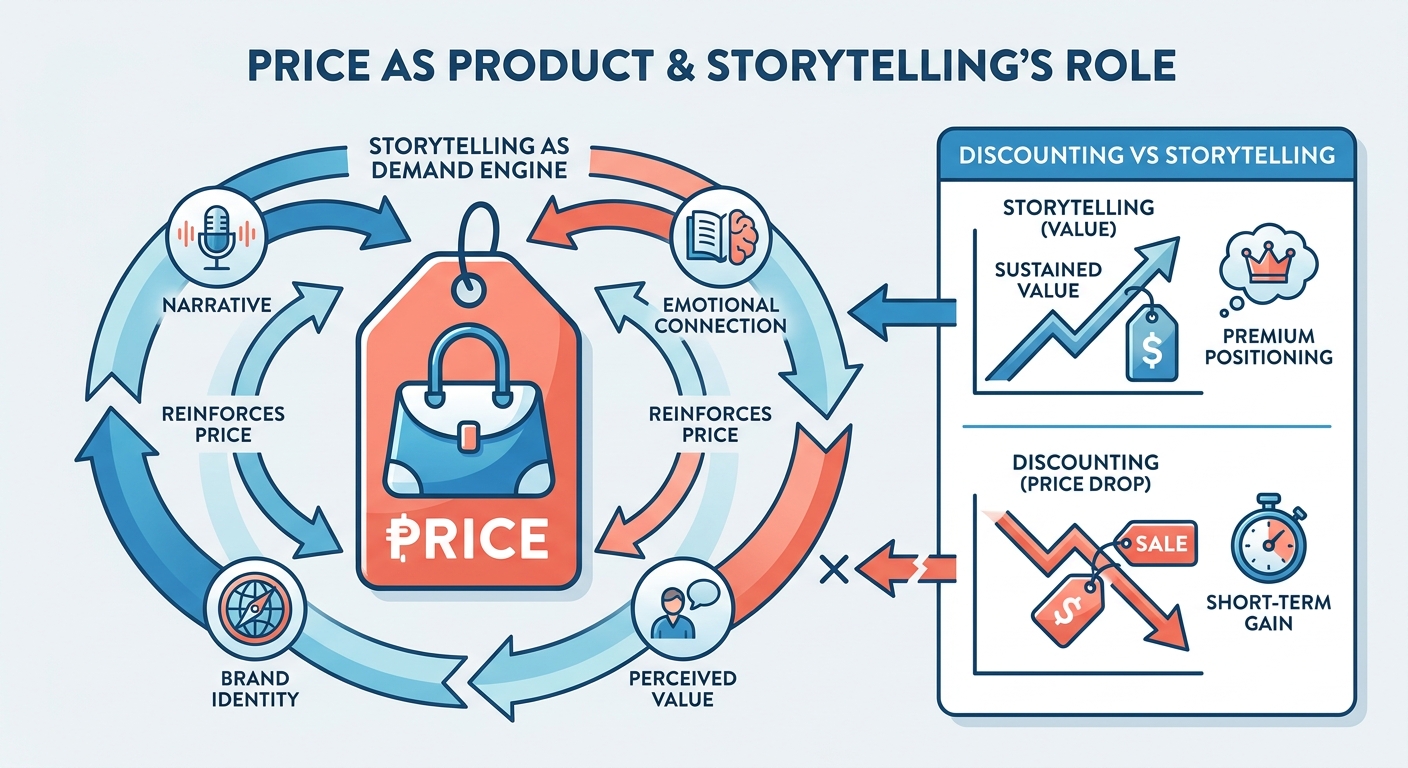
Why does price signal value in luxury?
Prestige pricing means the high price itself signals quality and status. Affluent buyers read a big number as proof of worth, so raising prices can attract them rather than scare them off. It flips the traditional demand curve on its head.
When heritage houses nudge prices up on their signature lines, they’re deliberately choosing brand equity over transaction volume, which you can see in recent pricing adjustments on classic flaps. Watchmaking runs the same play to protect its market placement, as this pricing analysis notes. The old definition still holds: real luxury depends on keeping the barriers to acquisition high, by design.
How do discounts erode brand equity?
Discounting reads as desperation, and desperation cascades into dilution. A study of downward price-based extensions tested 158 luxury consumers and found that lower prices erode brand concept consistency first, then personality, then purchase intention and loyalty. The damage runs deeper than one lost sale.
Coach is the cautionary tale. Its push into outlets hurt exclusivity and took a long recovery to undo. As one analyst put it: if you’re a luxury brand with outlet stores, maybe you’re not a luxury brand.
Here’s the honest carve-out. Price hikes aren’t a free lever either. Louis Vuitton, which has never discounted, recently posted a 3% revenue dip alongside quality complaints and some alienated younger buyers. The read: raising prices protects equity only when the story and the product back the number. Once price outruns the narrative, the same tactic can backfire.
What replaces the discount?
Editorial narrative becomes the demand mechanism. Instead of cutting price, luxury brands build desire through myth, experience, and scarcity. Hermès makes you develop a relationship before a Birkin. Gucci turns shopping into a gallery visit.
The sharpest example is Louis Vuitton’s Murakami collaboration. The non-limited Multicolore line carried a roughly 60% price premium yet built longer waitlists than the actual limited run, moving LV from logo-culture to designer-culture.
And because top-tier buyers signal status through quiet goods only they recognize, loud price cuts reach the wrong crowd entirely. Subtle editorial storytelling is the one channel that speaks to the people who pay the most.
Strategic alternatives to the markdown
If you can’t discount, what actually moves demand? The answer we keep landing on: you swap the price lever for better ones. For a core handbag line, that means earned access, scarcity, collaboration, and narrative. Each does the demand work a markdown would chase, without ever touching the retail price of a flagship style.
Start with earned access, the strategy that turns buying into a privilege. Require clients to build a transaction history and brand affinity over time, and the purchase becomes a milestone. The barrier isn’t a bug. It’s the product. When getting the bag takes effort, the bag carries the story of that effort.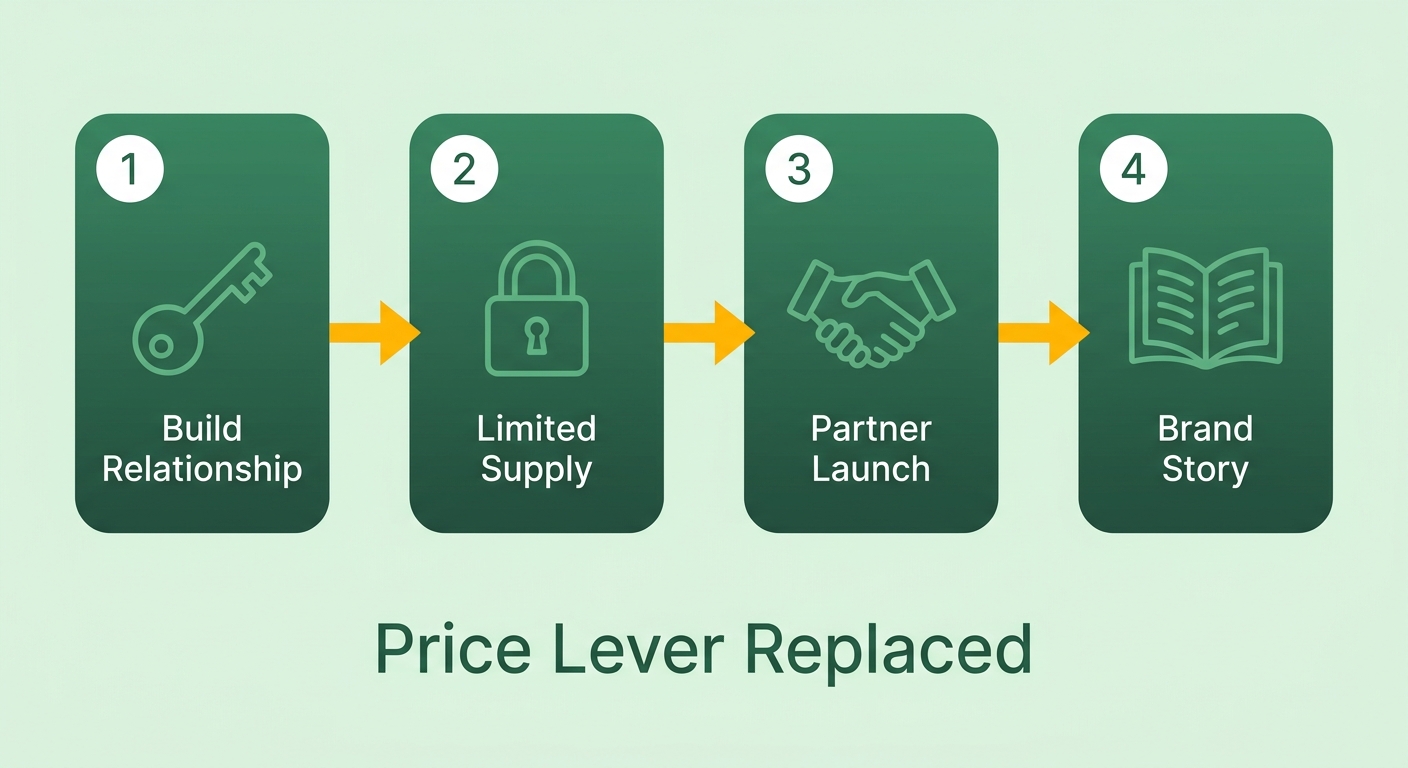
How do scarcity and collaboration replace discounts?
Limited runs and designer partnerships add fresh narrative to a core line, giving buyers a reason to act now that has nothing to do with saving money. A discount would flatten that spike. Scarcity and collaboration create it.
You can see this in the high-profile artistic partnerships documented in the cultural collaboration research. The 2003 “Cherry Blossom” release sold out worldwide and generated over $300 million in its debut year by blending fine art with classic canvas.
Then there’s the counterintuitive part. The 2017 Supreme x Louis Vuitton drop moved a full collection in a single release window, then resold at three to five times retail on the secondary market almost immediately. The waiting-list energy came from the cultural pairing, not the unit count. The story around the object, not the caps on supply, is what manufactured the scarcity signal.
By fusing streetwear energy with heritage craftsmanship, the brand generated huge cultural relevance while keeping its icon intact. That’s editorial storytelling doing the demand work a promotion would otherwise pay for.
When does a price hike backfire?
A price increase protects brand equity only when the narrative and quality justify the number. Push past that line and the same tactic that built prestige starts eroding it. The dividing line is whether a credible story backs the tag.
The sources genuinely disagree here, and it’s worth sitting with. One view holds that raising prices during downturns reinforces positioning. Yet the LV pricing and profitability study suggests that aggressive, compounding hikes can alienate the core aspirational customer and weaken secondary-market valuations.
Both are right, at different moments. Price hikes work while the editorial story and product quality keep pace. Once the number outruns the narrative, buyers notice, and the premium curdles into resentment.
Why extensions and inventory choices need a story
Brand extensions grow the parent only when they carry a distinct narrative, not just a lower price. Prada’s retail sales rose 17% on its Miu Miu line because Miu Miu is its own world, with its own point of view.
Contrast that with pure downward extensions. The academic research on downward price-based extensions indicates that cheaper variants under the same brand umbrella often dilute consumer trust and weaken long-term loyalty. So skip the cheaper-variant play on a core line. Build a new narrative instead.
Case studies: what the luxury handbag houses actually did
The clearest lesson from the case studies is that price only protects equity when a story is holding it up. Push the number without the narrative and the same tactic that saved one brand sinks another. That gap is where editorial storytelling does its quietest, most valuable work, and it explains why a premier heritage bag holds firm while a lesser bag on markdown does not.
Look at how the winners handled a downturn. Chanel raised prices during economic uncertainty and came out with a firmer ultra-luxury position. The hike worked because heritage and scarcity carried the number. A flagship style survives the same treatment for the same reason: the meaning is already priced in before the tag moves.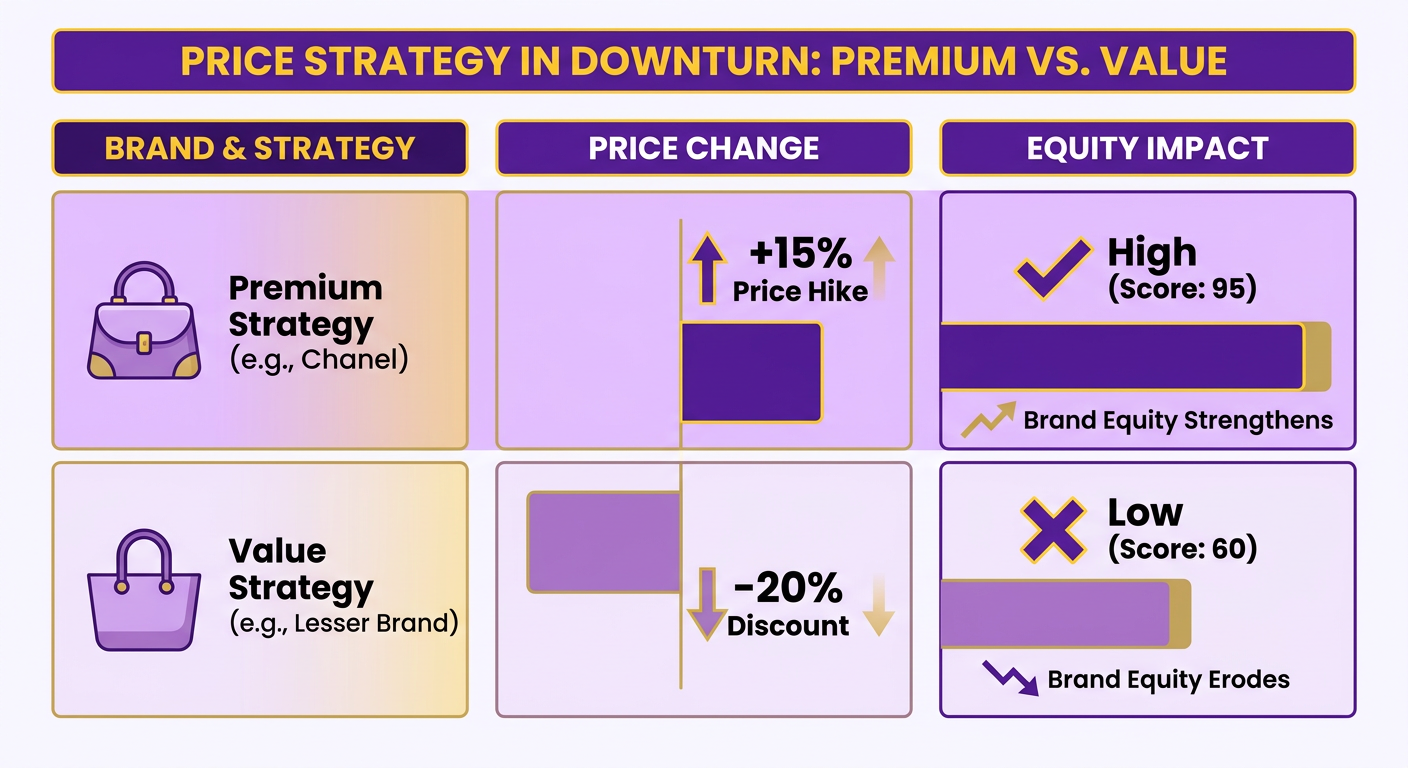
What happens when price outruns the story?
The tactic reverses. When a brand keeps pushing prices past what its narrative and quality can justify, the increases stop reading as prestige and start reading as greed.
That’s the tension in the sources. One argues price hikes reinforce luxury positioning. The Louis Vuitton pricing study highlights how aggressive adjustments can open a gap between cost and craftsmanship, dragging down consumer satisfaction. Same lever, opposite result.
The dividing line is credibility. Price protects equity only while the editorial story and the product quality back it up. The moment the number outruns both, buyers feel the gap. LVMH’s own CFO put it bluntly with “affordability isn’t the answer,” but the fix isn’t unlimited price hikes either. It’s re-earning the story.
Why do the quietest bags command the highest prices?
Because the buyers who pay most don’t want to be advertised to. The research on status signaling and brand prominence found that luxury handbags with less conspicuous branding often cost more, targeting consumers who value discretion over display.
This is the case study we find most useful. Loud branding tends to attract a broader, more trend-driven crowd, while minimalist designs appeal to a niche of ultra-high-net-worth buyers. Counterfeits, tellingly, copy the louder and cheaper products. So how do you speak to a high-value buyer who ignores billboards? Editorial narrative. It’s the one channel that reaches quiet, high-spend buyers without dragging the brand down-market.
What the failures teach
Both directions of price manipulation without narrative support fail. Diluting a brand through off-price channels measurably erodes perception and forces a long recovery. Raising prices too fast without matching improvements in product or story alienates core buyers. Burberry offers a third warning: burning unsold stock to protect scarcity generated headlines, public backlash, and a policy reversal. Proof that a manufactured signal collapses the moment buyers see the machinery behind it.
The safe corridor sits between them: narrative-driven value, where the story precedes the price rather than reacting to it. Set what the object means first, then set a price the story can defend. Skip the discount reflex. It solves a quarter and costs a decade.
Turning this into a working pricing strategy
If there’s one takeaway to carry out of this, it’s that price protection is a storytelling job, not a discounting job. Every tactic here points the same direction: for a core handbag line, the narrative around a premium product is what lets the number hold. Take the story away and the price becomes a liability. Keep the story strong and the price becomes proof.
So how do you put that into practice? Treat pricing and editorial as a single system. The number and the narrative rise together, or they don’t rise at all. That’s the honest resolution to a real tension in the research, and it’s where a disciplined handbag pricing strategy earns its keep.
How do you turn these takeaways into a pricing strategy?
Start by auditing whether your price is backed by a credible story. Then protect that story before you protect the margin. The sequence matters more than any single move.
- Anchor the price to meaning, not cost. Prestige pricing works because higher numbers signal quality, and even rounded figures read as more exclusive. Set the number the narrative can defend.
- Replace the discount lever with narrative levers. Scarcity, earned access, and collaboration do the demand work a markdown chases. A strict no-discount policy is a foundation, not a limitation.
- Feed a distinct story, not a cheaper version. Extensions that build their own world grow the brand. Ones that just lower the price point on the same concept dilute it.
Where the data comes in
Monitoring isn’t optional here. A no-discount policy only works while the product and the narrative justify the number, and analytics are how you catch the moment they stop.
Build a dashboard that pairs hard sales figures with soft signals. Track how long a flagship style holds full price before markdown pressure shows up in the resale market, since a healthy secondary price is one of the clearest proofs that the story still carries the number. Watch review sentiment on materials and construction, waitlist velocity on limited runs, and the share of purchases coming from repeat versus first-time buyers. Each tells you whether the narrative is doing its work before revenue does the talking.
Track sentiment and quality perception the way you track sell-through. When the story weakens, the fix is editorial and product, never a sale. Cut the price and you confirm the doubt.
What’s next for luxury handbag branding
The future belongs to brands that speak to their highest-value buyers through subtle narrative rather than loud promotion. Status signaling increasingly runs on cues only insiders recognize, which is exactly why price cuts and shouty ads reach the wrong crowd.
That’s the through-line of everything above. Editorial storytelling is your substitute price mechanism. It builds the desire a discount would otherwise buy, and it does it without ever touching the tag. Build the story first, price to match it, and monitor both like they’re the same asset. Because they are.
References
[1] No Discounts. No Exceptions: Why Luxury Brands Never … – https://fazer.agency/no-discounts-no-exceptions-why-luxury-brands-never-sell-sale/
[2] Luxury Brand Strategy: Managing Exclusivity And Availability – https://brandingstrategyinsider.com/2024/03/luxury-brand-strategy-managing-exclusivity-and-availability/
[3] Luxury Brand Exclusivity Strategies – An Illustration of a … – https://www.researchgate.net/publication/304197358_Luxury_Brand_Exclusivity_Strategies_-_An_Illustration_of_a_Cultural_Collaboration
[4] The Art of Pricing: How Luxury Brands Maintain Perceived … – https://lcbs.edu.in/the-art-of-pricing-how-luxury-brands-maintain-perceived-value/
[5] Louis Vuitton: A Study in Pricing Strategy and Profitability – https://medium.com/@hduru/louis-vuitton-a-study-in-pricing-strategy-and-profitability-45b346874d36
[6] Prestige Pricing: The Ultimate Guide – Valueships – https://www.valueships.com/post/prestige-pricing-the-ultimate-guide
[7] (PDF) The Luxury Strategy: Break the Rules of Marketing to Build … – https://www.researchgate.net/publication/281251957_The_Luxury_Strategy_Break_the_Rules_of_Marketing_to_Build_Luxury_Brands
[8] Signaling Status with Luxury Goods: The Role of Brand Prominence – https://www.researchgate.net/publication/228354996_Signaling_Status_with_Luxury_Goods_The_Role_of_Brand_Prominence
[9] (PDF) Downward price-based luxury brand line extension: Effects on … – https://www.researchgate.net/publication/361252317_Downward_price-based_luxury_brand_line_extension_Effects_on_premium_luxury_buyer’s_perception_and_consequences_on_buying_intention_and_brand_loyalty
Frequently Asked Questions
1. Why doesn’t discounting a luxury handbag increase sales volume?
Discounting signals the item was never worth its original price, which erodes the prestige that drove purchase intent. Affluent buyers interpret high prices as proof of quality, so lowering the number removes the status signal that motivated the transaction in the first place.
2. How does Hermès justify raising Birkin prices during economic downturns?
Hermès treats price increases as a reinforcement of exclusivity rather than a revenue tactic. When adjusting prices upward, the brand relies on its earned-access model and heritage narrative to maintain demand, positioning the hike as consistent with ultra-luxury status rather than reacting to market conditions.
3. Can a luxury brand extension grow the parent label without damaging it?
Extensions succeed when they carry a distinct narrative, not just a lower price. Prada’s secondary line succeeded because it built its own world, while research on luxury consumers found pure downward price extensions dilute brand concept consistency and buyer loyalty by weakening the parent’s positioning.
4. What happens when luxury brands push prices faster than product quality improves?
Price increases backfire when the narrative and quality cannot justify the number. Aggressive pricing adjustments can outpace perceived value, souring aspirational buyers and weakening resale confidence. The tactic protects equity only while the story and product back the tag; once the number outruns both, buyers notice the gap.
5. Why do quiet luxury handbags with minimal branding often cost more than logo-heavy styles?
High-net-worth buyers signal status through goods only their peers recognize, preferring subtle designs over conspicuous branding. Research shows affluent consumers favor quiet luxury that insiders identify, while loud logos attract aspirational buyers and counterfeiters. Discreet styles command premium prices because they speak exclusively to the highest-value segment.
6. How do luxury brands replace promotional pricing as a demand driver?
Brands manufacture desire through scarcity, earned access, and creative collaboration instead of discounts. High-profile artistic partnerships generate significant revenue without markdowns, while strict allocation models require relationship-building before purchase. Editorial storytelling and controlled supply do the demand work that promotions would otherwise chase.
7. What metrics should brands monitor to know when their no-discount strategy is weakening?
Track secondary market prices, review sentiment on materials, waitlist velocity, and repeat-buyer share alongside sales figures. A healthy resale price proves the narrative still supports the retail number, while declining quality perception or first-time buyer dominance signals the story is weakening before revenue reflects the damage.