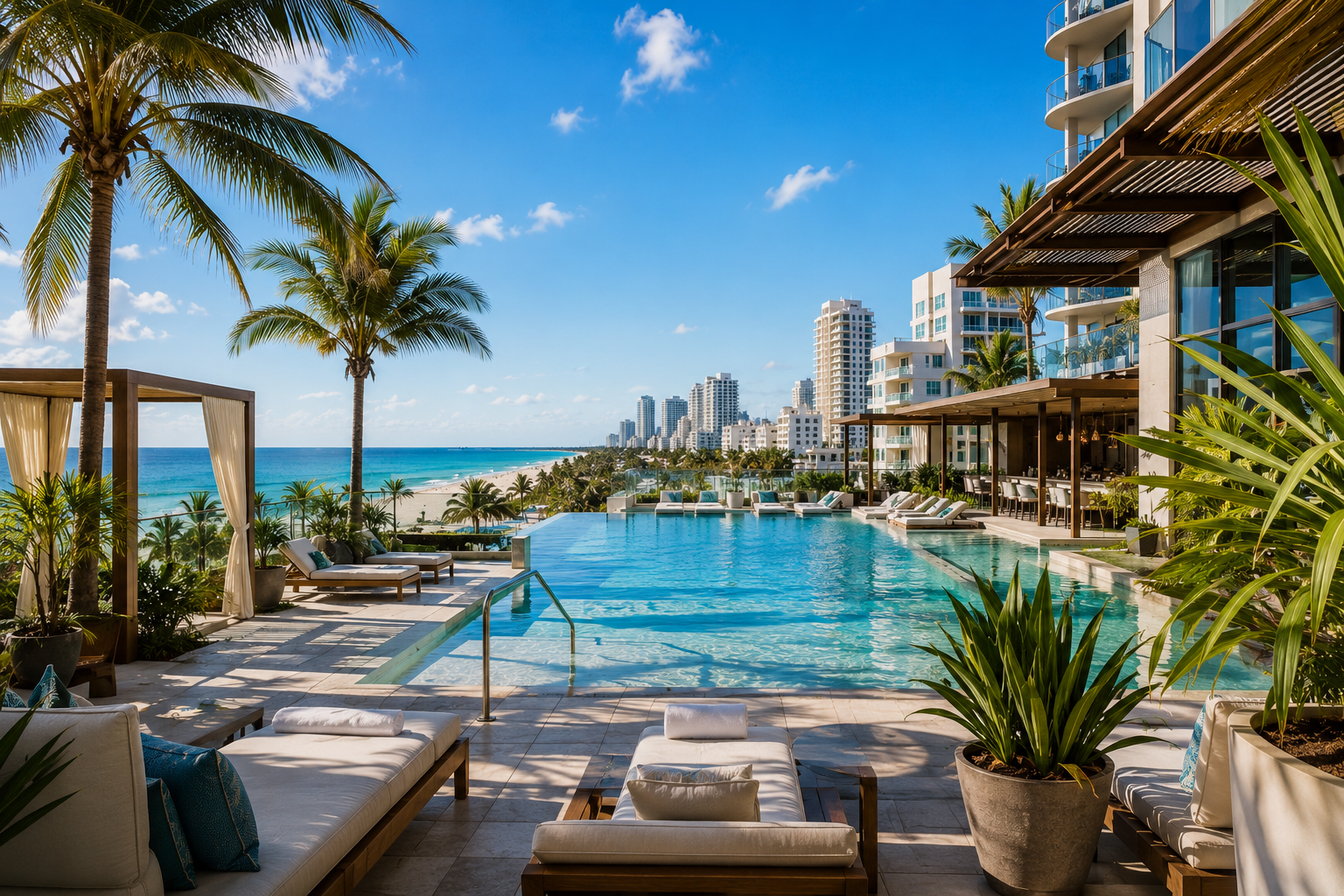
From legendary South Beach icons to intimate boutique escapes, Miami’s hospitality industry is entering a new era where culture, architecture and experience are changing the meaning of luxury.
By Industry Idols Editorial Team
Miami has always known how to make an impression.
Its beaches, nightlife, architecture and international appeal have made it one of the world’s most recognizable travel destinations. But in 2026, something more significant is unfolding behind the doors of the city’s most celebrated hotels.
A new generation of hospitality is emerging, and it is no longer defined simply by ocean views, expensive suites or rooftop pools.
Across Miami Beach, Little Havana and Bal Harbour, established hotels are reinventing themselves, international brands are entering the market, and independent operators are introducing intimate experiences built around culture, creativity and local identity.
Miami isn’t just opening new hotels. It’s redefining what makes a destination worth experiencing.
From the highly anticipated return of Delano Miami Beach to boutique concepts celebrating the city’s Cuban heritage, these 10 properties offer a compelling look at the future of hospitality in South Florida.
1. Delano Miami Beach: The Return of a South Beach Legend
Few properties are as closely connected to Miami Beach’s identity as the Delano.
Originally built in 1947, the Collins Avenue landmark became an international symbol of South Beach glamour following its transformation under hospitality visionary Ian Schrager in 1995.
Its distinctive design, legendary social scene and celebrity clientele helped establish an era of Miami nightlife that influenced hospitality far beyond Florida.
After closing in 2020, the Delano made its comeback in 2026 following an extensive restoration reportedly valued at approximately $100 million.
Now operating under Ennismore, the reimagined hotel features 171 guestrooms and suites, signature poolside bungalows, wellness experiences and a private members club.
Its culinary offerings introduce two internationally recognized restaurant concepts to the United States: Gigi Rigolatto and Mimi Kakushi.
The transformation reflects something larger than a renovation.
Rather than abandoning its history, Delano is building on the cultural significance that made it famous while introducing experiences designed for a new generation of travelers.
The Delano’s comeback proves that true luxury is not simply about being new. It’s about remaining relevant.
2. UNFRAMED: Where Architecture Becomes the Attraction
In a city celebrated for its architecture, standing out requires more than an attractive building.
UNFRAMED, Autograph Collection Miami Beach, opened in April 2026 near Lincoln Road with a striking architectural identity.
The 150-room property features a distinctive rippling exterior designed by French architect Rudy Ricciotti, while interior designer Gulla Jónsdóttir brings a contemporary aesthetic to its guestrooms and public spaces.
Rich colors, dramatic windows and carefully considered design elements create an atmosphere intended to feel as visually compelling as the destination surrounding it.
A rooftop pool and the Vilebrequin La Plage restaurant add to the property’s lifestyle positioning.
What makes UNFRAMED particularly interesting is the role architecture plays in its identity.
In an age when travelers often discover destinations through Instagram, photography and short-form video, the building itself becomes part of the experience.
For hospitality brands competing for international attention, distinctive design is no longer merely decorative.
It can become one of their most valuable storytelling assets.
3. Hotel Casa Cañita: A Celebration of Cuban Culture
Luxury hospitality doesn’t always require hundreds of rooms or an internationally recognized hotel brand.
Sometimes its greatest strength is personality.
Located on Miami Beach’s iconic Ocean Drive, Hotel Casa Cañita introduces a more intimate approach to hospitality through a collaboration between acclaimed Miami chef Michelle Bernstein and her sister, interior designer Nicolette Bernstein.
With just 24 rooms and suites, the boutique property draws inspiration from Cuba’s golden age, incorporating cultural influences, live music and Cuban cuisine.
The concept offers visitors something beyond a place to sleep.
It creates an opportunity to experience a carefully developed interpretation of Miami’s cultural heritage.
That approach is particularly meaningful in a city where Cuban influence has shaped everything from food and music to architecture, business and neighborhood identity.
Casa Cañita demonstrates how independent properties can compete by developing an authentic sense of character rather than attempting to imitate larger luxury resorts.
Its greatest asset is not its size. It’s its story.
4. El Jardín Inn: Bringing Little Havana Into the Hospitality Spotlight
For decades, Miami’s hospitality identity has been closely associated with beachfront resorts.
El Jardín Inn offers a different perspective.
Opened in March 2026, the 18-room boutique hotel occupies a transformed 1940s-era Art Deco apartment building near Calle Ocho in Little Havana.
Rather than creating an environment disconnected from its surroundings, the property embraces the neighborhood’s cultural character.
Its courtyard provides a gathering place for curated events, including wellness activities, film nights and community-focused programming.
Guests are also positioned near the restaurants, galleries, music venues and historic businesses that make Little Havana one of Miami’s most recognizable neighborhoods.
That connection is important.
Modern travelers increasingly seek experiences that provide a stronger relationship with the places they visit.
Properties like El Jardín Inn reflect a model in which the surrounding community becomes an essential part of the guest experience.
Instead of bringing the neighborhood into the hotel, El Jardín encourages guests to discover the neighborhood for themselves.
5. The Shelborne by Proper: A Historic Address Finds New Energy
Miami Beach’s historic hotels hold an advantage that newer developments cannot easily replicate: decades of cultural identity.
But maintaining that relevance requires continued investment and imagination.
The Shelborne by Proper represents one of the city’s notable examples of historic hospitality reinvention.
Following a major renovation, the Collins Avenue property has entered a new chapter under Proper Hospitality.
Its transformation incorporates contemporary interiors, redesigned accommodations, refreshed public spaces and a renewed emphasis on dining, social experiences and beachfront living.
Rather than treating the property’s history as something to replace, the redesign uses that heritage as part of its appeal.
The result reflects an important direction for Miami Beach.
Historic properties do not necessarily need to compete by becoming unrecognizable.
They can preserve the architecture and identity that made them significant while offering modern experiences that appeal to today’s travelers.
For established hotels, that balance between preservation and reinvention may be one of the most valuable competitive advantages available.
6. Loews Miami Beach Hotel: Modernizing Luxury on a Grand Scale
While boutique hotels attract attention through intimacy and individuality, larger properties face an entirely different challenge.
They must evolve while maintaining the consistency expected by thousands of returning guests.
Loews Miami Beach Hotel has approached that challenge through a $55 million redesign encompassing its 790 guestrooms and suites.
The investment also introduced updated culinary offerings, including Bistro Collins and The Sushi Bar.
For a major beachfront property, a transformation of this scale represents more than a visual refresh.
It is an investment in maintaining relevance within an increasingly competitive hospitality market.
Today’s travelers evaluate the complete experience, including accommodations, service, restaurants, atmosphere and opportunities to connect with the destination.
By modernizing its offerings while preserving its established identity, Loews demonstrates how large-scale hospitality brands can remain competitive without losing what made them successful.
In Miami’s evolving luxury market, reputation creates expectations. Continued investment helps meet them.
7. Royal Palm South Beach: A $100 Million Reinvention
Another significant transformation along Miami Beach’s famous coastline comes from Royal Palm South Beach Miami, a Tribute Portfolio Resort.
The historic oceanfront property reopened in July 2026 following a comprehensive renovation valued at more than $100 million.
Its redesign introduces a French Riviera-inspired atmosphere, with updated guestrooms, refreshed common areas and a reimagined poolside environment.
The transformation also emphasizes dining, social spaces and event experiences.
The investment illustrates the confidence major hospitality owners continue to place in Miami Beach.
But it also highlights a changing competitive landscape.
For decades, a prime beachfront address could serve as the defining feature of a luxury property.
Today, location remains valuable, but the experience surrounding that location has become increasingly important.
Royal Palm’s transformation is another example of established hotel brands investing in more distinctive identities to appeal to modern travelers.
8. The Ritz-Carlton Bal Harbour: Elevating an Established Luxury Experience
At the northern edge of Miami Beach, The Ritz-Carlton Bal Harbour is preparing for another chapter in its luxury hospitality story.
The 108-room property, positioned near Haulover Inlet, is undergoing a major transformation encompassing accommodations, the oceanfront pool environment, restaurants, spa and fitness facilities.
Its reopening has been targeted for December 2026.
The renovation reflects the demands facing established luxury brands.
Affluent travelers increasingly have access to exceptional hospitality experiences around the world, raising expectations for properties operating in premium destinations.
Maintaining a recognizable brand name is important, but it is no longer sufficient by itself.
Design, wellness, privacy, service and overall atmosphere all contribute to how travelers evaluate a luxury stay.
For The Ritz-Carlton Bal Harbour, the renovation represents an opportunity to strengthen its position in one of South Florida’s most exclusive hospitality markets.
9. Hilton Miami Beach Hotel: A New Chapter for Art Deco Hospitality
Miami Beach’s architectural heritage remains one of the city’s most recognizable cultural assets.
The planned Hilton Miami Beach Hotel near Collins Park aims to demonstrate how that history can support a contemporary hospitality experience.
Expected to debut in December 2026, the property is being developed within a historic Art Deco building.
Plans include redesigned accommodations, three dining concepts, an elevated pool deck and a 24-hour fitness facility.
The project reflects the continuing appeal of adaptive reuse, an approach that gives established buildings a new purpose while retaining elements of their architectural character.
For Miami Beach, that strategy carries particular significance.
Its historic Art Deco landscape is not simply a collection of attractive buildings. It is an essential part of the destination’s international identity.
Preserving that connection while introducing contemporary amenities allows hospitality operators to build on the city’s history rather than compete against it.
10. The Dean: An International Brand Chooses Miami
Miami’s hospitality evolution is also attracting brands looking to establish a stronger presence in the United States.
The Dean, an Irish hospitality brand, is preparing to make its American debut through a planned transformation of the former Gates Hotel in South Beach.
The 235-room property is expected to become the brand’s U.S. flagship, with a debut targeted for late 2026.
The project reflects Miami’s growing importance as a gateway for international hospitality concepts.
With its global tourism appeal, cultural diversity, influential culinary scene and international business connections, Miami offers brands an opportunity to introduce themselves to a broad and highly visible audience.
The Dean’s planned arrival reinforces a larger trend: Miami is increasingly being viewed not just as a vacation destination, but as a market where global lifestyle and hospitality brands can establish their identities.
The Bigger Picture: Miami’s Hospitality Industry Is Changing
Taken individually, these 10 properties represent different approaches to hotel development and reinvention.
Together, they reveal a much larger transformation.
Delano is using its cultural legacy to create a new luxury experience.
UNFRAMED is placing architecture at the center of its identity.
Casa Cañita is building a hospitality concept around Cuban culture.
El Jardín Inn is embracing its relationship with Little Havana.
The Shelborne, Loews and Royal Palm are demonstrating the importance of reinvesting in established properties.
Meanwhile, The Ritz-Carlton Bal Harbour, Hilton Miami Beach and The Dean represent additional chapters in the evolution of Miami’s luxury and lifestyle hospitality market.
What connects these projects is not a particular design style, price point or guest demographic.
It is the understanding that travelers increasingly want more from the places they choose to stay.
They want memorable experiences, meaningful surroundings, engaging restaurants, distinctive design and connections to local culture.
The hotel is no longer simply where the experience begins and ends. The hotel has become part of the destination itself.
Why Miami’s Hotel Renaissance Matters Beyond Tourism
The significance of Miami’s hospitality transformation extends well beyond the travel industry.
Every major hotel opening or renovation creates opportunities across an interconnected business ecosystem.
Architects, interior designers, restaurateurs, photographers, filmmakers, marketing agencies, event producers, wellness professionals and creative entrepreneurs all contribute to the experiences these properties deliver.
A hotel opening can introduce new dining destinations, employment opportunities, entertainment concepts and cultural programming.
A major renovation can also reposition an existing property within the city’s social and commercial landscape.
For South Florida’s creative and entrepreneurial communities, the changing hospitality market presents opportunities to build relationships with brands investing in the region.
It also places greater importance on storytelling.
In a market where multiple hotels can offer beautiful rooms and exceptional amenities, the ability to communicate a distinctive identity becomes a powerful business advantage.
The most memorable hospitality brands are often those that give people something meaningful to talk about long after their visit.
What’s Next for Miami Hospitality?
The momentum behind Miami’s hotel industry extends beyond 2026.
Several major projects are already planned for the years ahead.
French luxury hospitality group Barrière is developing Fouquet’s Hotel & Residences in the Miami Design District, with an opening targeted around 2030.
Mandarin Oriental is also planning a new luxury property on Brickell Key.
Other developments, including Aman Miami Beach, the Shore Club’s transformation under Auberge and the Grand Hyatt Miami Beach, point toward continued investment in the city’s hospitality infrastructure.
Although development timelines can change, the direction is clear.
Miami continues to attract brands seeking to establish or expand their presence in one of the world’s most internationally recognized destinations.
And as that