From the pressures of healthcare to the freedom of artistic expression, Meliza Ruby Abreu is transforming her Dominican heritage, personal experiences, and creative vision into a body of work that speaks to resilience, identity, and the stories women carry.
By Chris Caprice | Industry Idols
Some artists create to be seen. Others create so that people can finally see themselves.
For Dominican artist Meliza Ruby Abreu, the woman behind By Melrub and the deeply personal creative universe of Dear Diary by Ella, art has become more than a form of expression. It is a language of identity, healing, cultural memory, and transformation.
Her work explores the emotions and experiences that often go unspoken, particularly the quiet battles women navigate as mothers, immigrants, dreamers, and individuals learning to rebuild themselves.
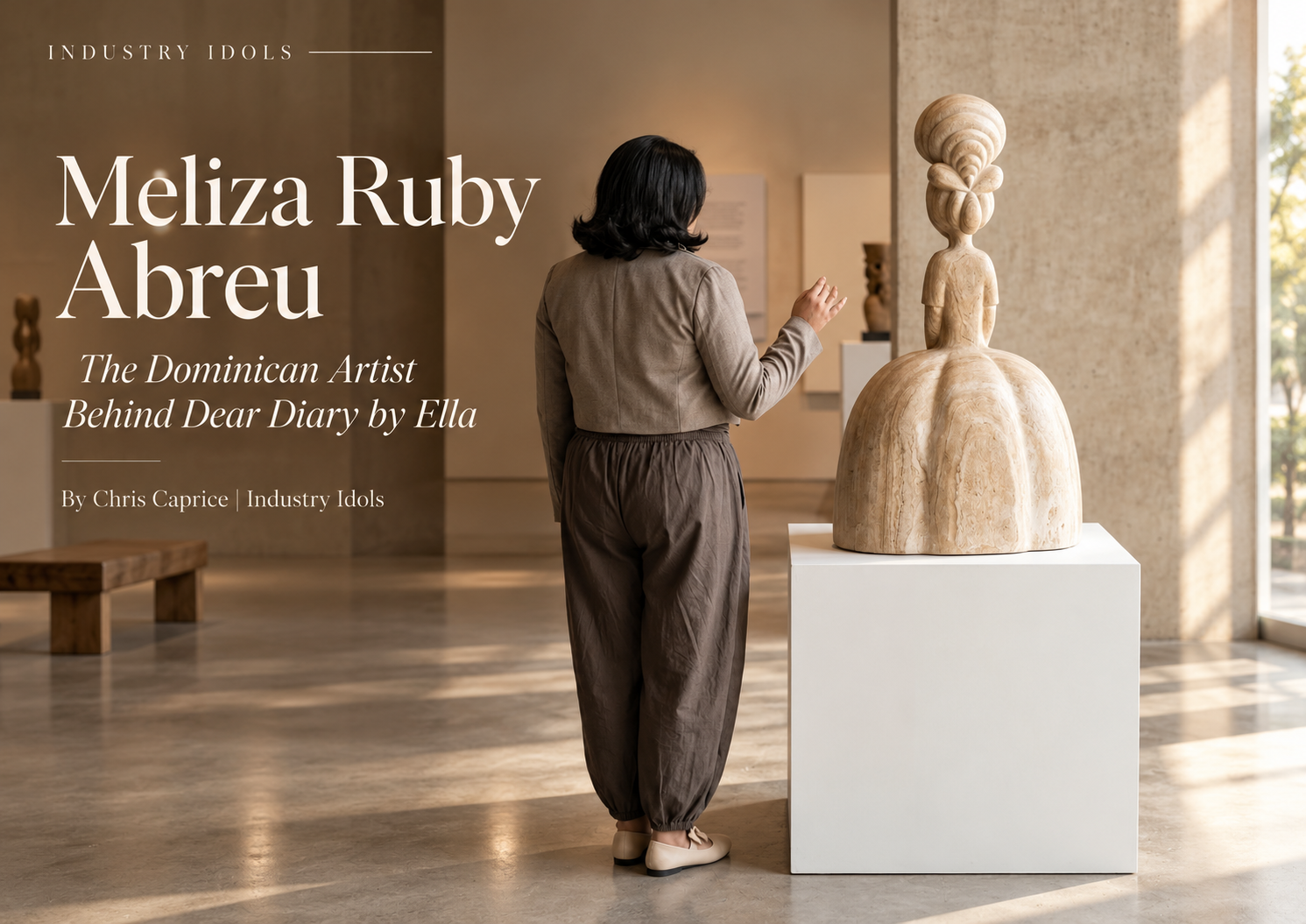
At the center of this artistic world stands Ella, a faceless character who deliberately turns her back to the viewer.
It is a simple visual choice with a powerful message: Ella could be anyone.
But before creating this symbolic figure, Abreu was living an entirely different life.
From Healthcare to a Life of Art
Long before By Melrub became her creative identity, Abreu was balancing two demanding worlds.
During the day, she worked as a clinical lead in urgent care, operating in a high-pressure medical environment where responsibility and urgency defined her schedule.
At night, she returned home to an entirely different kind of work.
Her table became a makeshift art studio, covered with Chinese ink, vintage books, spray paint, and resin. What began as a personal outlet gradually evolved into something she could no longer ignore.
Art had always been part of her life.
Growing up, she watched her mother sketch portraits and crochet with dedication, introducing her to the patience, creativity, and emotional connection that would later define her own work.
For years, Abreu maintained what she describes as a double life, balancing the professional responsibilities of healthcare with an increasingly powerful creative calling.
Eventually, the balance shifted.
Her passion for art had outgrown the limited hours she could dedicate to it.
Rather than continuing to treat creativity as something reserved for the evenings, she made the decision to pursue it fully.
That decision gave birth to By Melrub.
It was more than a career change. It represented a decision to build a life around something that had always been part of her identity.
Dominican Roots, Cultural Memory, and the Materials of Home
For Abreu, her Dominican heritage is not simply a biographical detail. It is fundamental to how she sees the world and approaches her work.
Her roots trace back to Puerto Plata, Dominican Republic, where she developed an appreciation for resourcefulness, community, and the ability to discover beauty in unexpected places.
Those influences remain present in her artistic vocabulary.
Warm Caribbean-inspired palettes, gold leaf, textured surfaces, and traditional materials help connect her contemporary creations to the place she calls home.
One particularly meaningful material is larimar, the distinctive blue stone associated with the Dominican Republic.
Its presence in her artistic vision represents more than an aesthetic choice. It connects her work to the island’s landscape, identity, and cultural heritage.
Although Abreu now lives in South Florida, the Caribbean remains an unmistakable influence.
Her art reflects the experience of carrying one’s homeland across borders, preserving familiar emotions and cultural memories while building a new chapter elsewhere.
In many ways, her work speaks to the larger Dominican diaspora, where identity is not determined solely by geography but also by the traditions, stories, and values people carry with them.
Dear Diary by Ella: The Woman Without a Face
Among Abreu’s most personal creations is Dear Diary by Ella, an artistic storytelling project built around a female character whose face remains intentionally unseen.
Ella is frequently portrayed from behind, her identity left open to interpretation.
There is no defined expression telling viewers what to feel. No single face determining who she represents.
That absence is precisely the point.
According to Abreu, Ella emerged from an intimate moment in her life and became a way to express women’s silent struggles, resilience, and personal growth without restricting the character to a single identity.
Ella represents the mother navigating responsibilities while rediscovering herself.
She represents the woman who has migrated to another country in search of opportunity.
She represents the dreamer confronting uncertainty and the individual rebuilding her life without needing to perform strength for the outside world.
By refusing to give Ella a visible face, Abreu allows the audience to become part of the story.
The character becomes a mirror.
What makes Dear Diary by Ella especially compelling is its refusal to define womanhood through one experience or expectation.
Instead, Ella offers something more inclusive: a space where different stories can coexist.
For Abreu, storytelling is not necessarily about explaining every emotion.
Sometimes, it is about creating something that allows others to recognize feelings they have never been able to put into words.
Creating Art That Invites People to Slow Down
In a culture increasingly shaped by constant notifications, short-form content, and digital consumption, Abreu takes a different approach.
Her art asks viewers to slow down.
Her creative process relies heavily on tactile materials, including raw wood, acrylic, spray paint, pages from vintage books, and substantial layers of resin.
These materials produce surfaces that invite closer observation.
Rather than presenting every detail immediately, her pieces encourage viewers to discover the stories embedded within their layers.
The physical nature of the work is essential to its emotional purpose.
Whether someone encounters one of her paintings or stands before a larger mural, Abreu hopes the experience creates a moment of calm and reflection.
She wants people to look beyond the immediate image, explore the layers, and find something meaningful within their own experiences.
This philosophy positions her work at the intersection of visual art and emotional storytelling.
The objective is not merely to decorate a space.
It is to create a connection.
Taking Dominican Art Into Public Spaces and New Collaborations
As her career has developed, Abreu has expanded beyond her personal studio into cultural exhibitions, public art, creative partnerships, and community-centered projects.
Among the experiences she identifies as particularly meaningful is exhibiting her artwork at the Dominican Consulate in Miami, an opportunity she describes with pride because of its connection to her heritage and the Dominican diaspora.
Her community-focused work has also taken her into public spaces in West Palm Beach.
Abreu says she has worked alongside Commissioner Joel Flores on mural initiatives intended to transform public environments while inspiring the surrounding community.
These projects reflect her belief that art should not exist exclusively within traditional galleries.
It can also occupy neighborhoods, community spaces, and environments where people encounter it as part of everyday life.
Her creative collaborations have extended into media and commercial projects.
Abreu cites work with Rose Mary News and Conversaciones con la Diáspora, platforms focused on amplifying stories and voices within the community.
She also describes designing media kits and customizing Nike Air Force 1 sneakers for a Johnnie Walker and SoleFly collaboration associated with the 2026 Scotch and Sneakers Tour.
For an artist whose process incorporates unconventional materials and layered storytelling, the movement between fine art, footwear customization, media design, and public installations reflects an expansive creative approach.
Abreu also reports receiving recognition at the Latin Business Awards at the Telemundo Center as a meaningful milestone.
Her commitment to art with a purpose extends to philanthropic contributions, including donating work from The Art of Treasuring a Book to the Biarco VI auction supporting Colombia.
Among her notable artistic creations, she identifies Ella and Los Olivos del Tiempo as important pieces in her evolving body of work.
Together, these experiences illustrate an artist seeking to connect cultural expression with public engagement and community impact.
Bringing Ella Into the Third Dimension
While Dear Diary by Ella began as an intimate visual and emotional concept, Abreu is now exploring how the character can evolve beyond two-dimensional artwork.
One of her current projects involves transforming Ella into three-dimensional sculptures carved from Dominican larimar.
The direction is significant.
A character originally designed to reflect personal stories and emotional experiences is being reimagined through a material closely connected to Abreu’s cultural identity.
The approach brings together two central elements of her artistic journey: the universal experiences represented by Ella and the distinct Dominican heritage that continues to inspire her.
Her plans also extend to larger gallery exhibitions, architectural resin panels, additional murals in West Palm Beach, and continued community projects with Rose Mary News and the Diaspora & Development Foundation.
These ambitions suggest an artist who sees few boundaries between traditional artistic disciplines.
For Abreu, paintings, sculptures, murals, and architectural installations can all become vehicles for storytelling.
What matters most is the emotional connection they create.
An Artistic Identity Beyond Borders
Meliza Ruby Abreu’s journey is ultimately a story about choosing creativity, preserving identity, and finding purpose through artistic expression.
Her transition from healthcare to the arts illustrates the courage required to pursue a calling that does not always fit within conventional expectations.
Her Dominican roots provide the cultural foundation.
Her materials give those experiences physical form.
And through Ella, she has created a character capable of representing countless individual stories without belonging exclusively to any one person.
In an industry where visibility is often treated as the ultimate measure of success, Abreu’s most recognizable character offers a different perspective.
Ella does not need to show her face to be understood.
Perhaps that is what makes her so relatable.
Because sometimes, the most powerful stories are not the ones that tell us who to be.
They are the ones that remind us who we already are.
About the Artist
Meliza Ruby Abreu is a Dominican diaspora artist based in South Florida and the founder of By Melrub. Her multidisciplinary work explores cultural identity, emotional storytelling, tactile materials, and community engagement. She is also the creator of Dear Diary by Ella, an artistic project centered on resilience, womanhood, and personal transformation.
Instagram: @bymelrub | @deardiarybyella
Industry Idols | Stories That Move the Culture