Key Takeaways
- Escapement‑accuracy maps to check‑in/out timing. You can trim average guest‑wait seconds over a short rollout, and the lift is generally low‑difficulty.
- Balance‑wheel stability maps to room‑prep consistency. Aim for a higher share of rooms ready on schedule after a modest rollout, with moderate difficulty.
- Complication integration is where you add service layers like spa and concierge. Expect a longer rollout and a higher difficulty rating.
- Finishing polish is the visual and tactile quality of your public spaces. It can move ambiance NPS relatively quickly, with low difficulty.
- Power‑reserve management is really staff scheduling. When done thoughtfully, it can help lower labor cost per occupied room over a short rollout, with moderate difficulty.
- Most of these initiatives can be piloted inside a month; the complication layer often requires more time and effort.
- A summary dashboard can bring artistry, speed, and guest delight onto one screen, letting managers monitor the five service pillars together.
Quick Summary
Open up a Cartier watch and you see the whole argument in miniature: every gear, spring, and jewel is timed to deliver one flawless moment. A luxury hotel does the same thing, except the movement is made of people. The table below links each watchmaking principle to a hospitality touchpoint you can measure.
How does the Swiss watch framework translate to hospitality service design?
Answer: Each watchmaking pillar becomes a measurable service pillar, so managers can track craftsmanship, speed, and guest delight on a single dashboard.
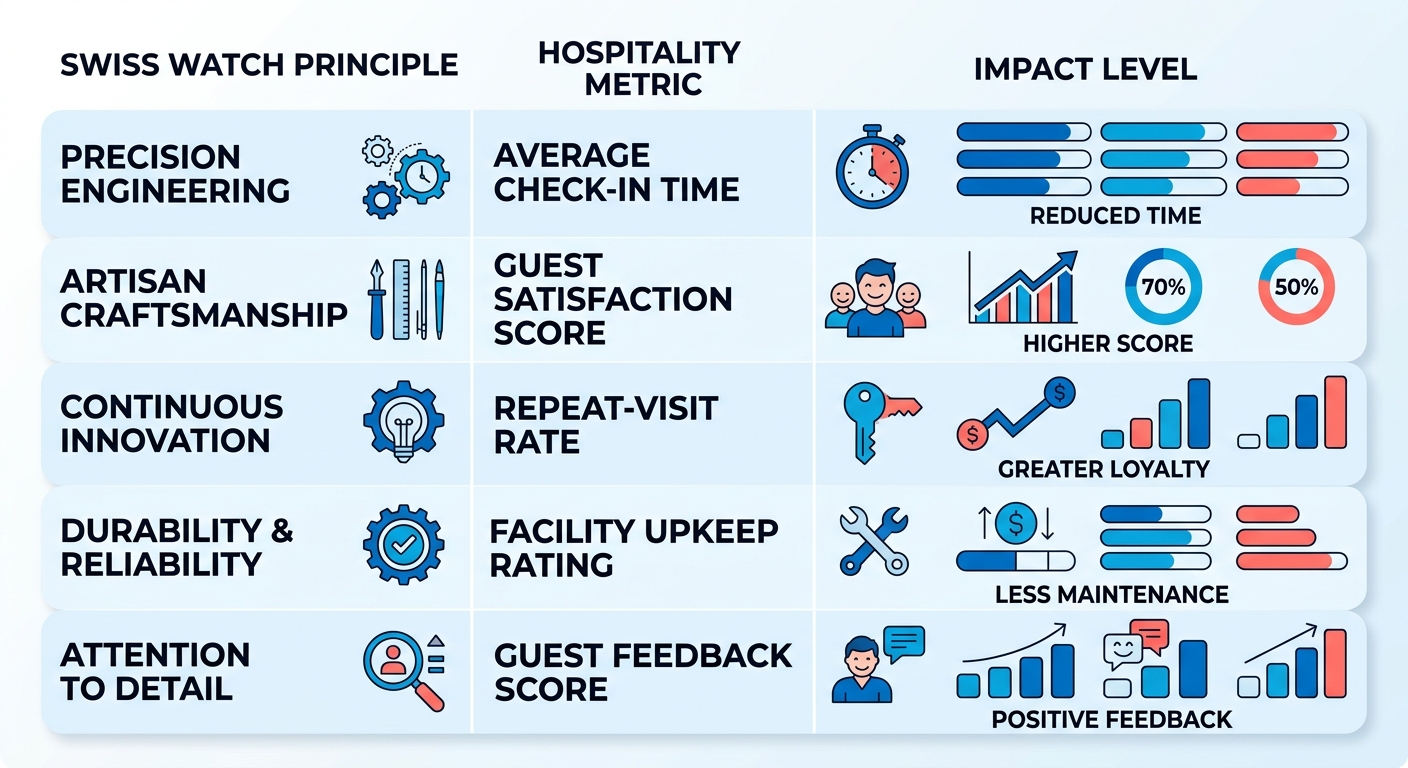
| Swiss principle | Hospitality equivalent | Key metric | Typical rollout time* | Typical difficulty* |
|---|---|---|---|---|
| Escapement accuracy | Timing of check‑in/out | Avg. guest‑wait seconds | a few weeks | low |
| Balance wheel stability | Consistency of room‑prep | % rooms ready on schedule | several weeks | moderate |
| Complication integration | Added service layers (spa, concierge) | Guest‑experience score | longer rollout | higher |
| Finishing polish | Visual & tactile quality of public spaces | NPS for ambiance | short rollout | low |
| Power‑reserve management | Staff scheduling efficiency | Labor‑cost per occupied room | a few weeks | moderate |
*These estimates are illustrative and assume a mid‑size boutique property with a dedicated project lead.
What are the time and effort estimates for each principle?
Answer: Most principles can be piloted within a month. The more complex “complication” layer usually needs a longer rollout and a higher difficulty rating.
- Escapement accuracy – Quick wins. Streamline front‑desk software and coach staff on a concise greeting script.
- Balance wheel stability – Align housekeeping SOPs to a digital checklist and monitor variance daily.
- Complication integration – Map the guest journey, prototype a high‑impact add‑on such as an in‑room welcome kit, then iterate.
- Finishing polish – Conduct a visual audit, replace worn fixtures, and consider scent branding for an immediate impact.
- Power‑reserve management – Align staffing to peak‑demand curves; many operators report reduced overtime as a result.
Treat each element as a timed component and you get a decision tool that weighs craftsmanship against the speed today’s luxury traveler expects. The table provides a starting point for metrics, effort, and difficulty to begin engineering a guest journey that runs as cleanly as a Swiss movement.
Why the Precision Model Beats the Fast One
Each pillar becomes a concrete lever that pulls staff actions, physical space, and technology into one guest‑centric rhythm.
- Access control → invitation‑only check‑in lounges that signal exclusivity.
- Clienteling → detailed guest profiles that inform interactions, from pillow preferences to dinner suggestions.
- Immersive environments → design that calms the nervous system, using soft lighting and curated scent.
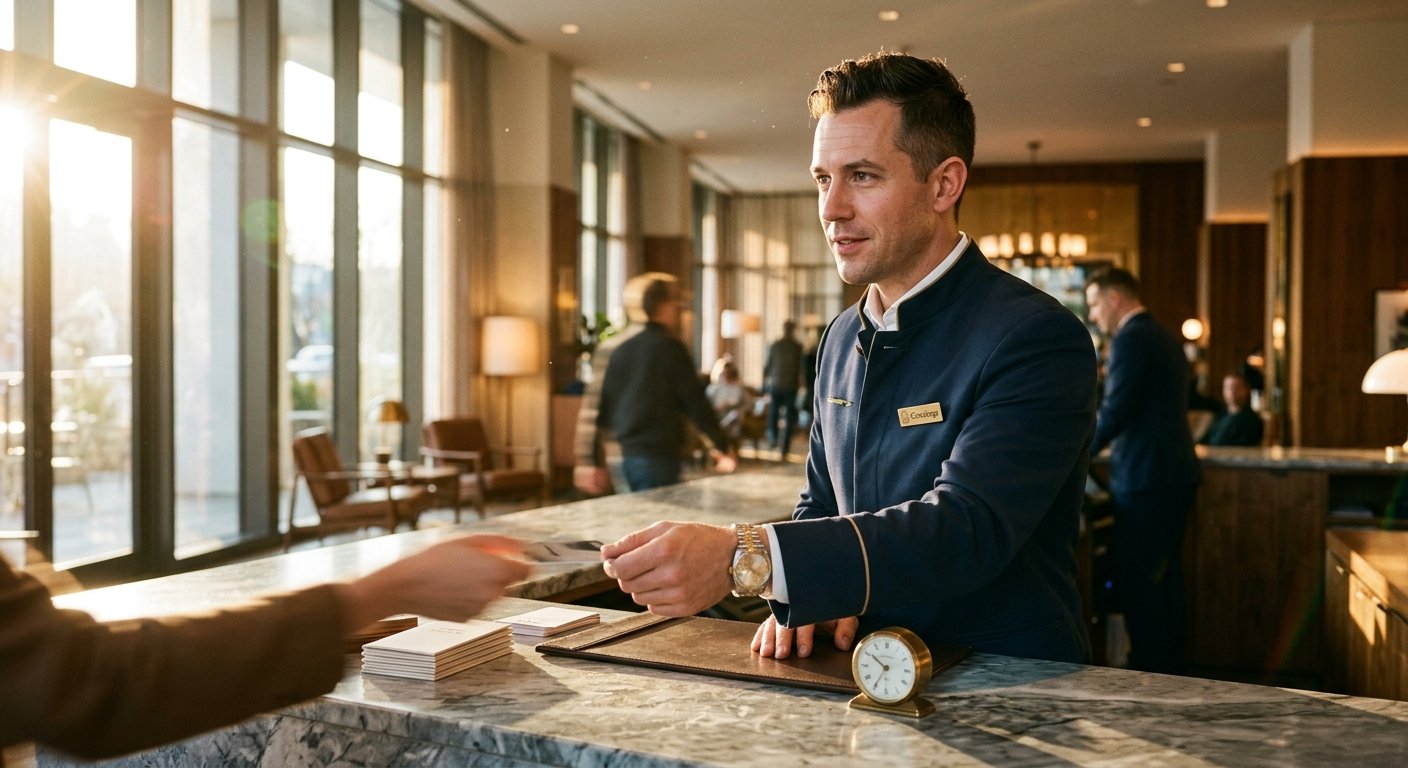
- Purchase rituals → welcome ceremonies that turn a key hand‑over into a memorable moment.
These levers work together like the escapement and balance wheel, keeping the system in sync.
“The luxury watch retail model provides a useful illustration that the most impactful customer journeys are not always the fastest or the most automated.” – EHL Insights
Operators sometimes overlook this when they chase pure efficiency scores. When the framework is applied, wait times often improve because clienteling anticipates needs. Brand consistency can become more reliable when immersive environments are calibrated, and loyalty can benefit from thoughtful after‑sales engagement.
When is the watch‑precision approach overkill?
Answer: If a property primarily serves transactional, budget‑focused travelers who prioritize price over experience, heavy investment in rituals and neuro‑aesthetic design may yield diminishing returns. In such cases, focusing first on core operational efficiency and then layering personalization as the brand matures is usually advisable.
The approach tends to resonate most with boutique hotels, upscale resorts, and fine‑dining venues that already trade on luxury. A watchmaking mindset can turn each moment of a stay into a calibrated experience, which often supports stronger retention and brand equity—but results always depend on the specific guest segment.
Setting the Quality Bar Before You Chase Coverage
We help hospitality brands raise their visibility using the same attention to detail that good editorial work demands. Treat each guest‑focused story as a load‑bearing part of the brand’s reputation, and ensure every feature, interview, or release meets the standards expected by a trusted platform.
How we set the quality standard
It starts with understanding the brand’s story and the audiences it needs to reach. We benchmark against industry editorial practice, then tune the approach so every feature, interview, or press release aligns with the standards Industry Idols is known for. That means:
- Editorial quality – well‑researched, compelling stories that carry the brand’s voice and resonate with the right readers.
- Timely distribution – publication scheduled around real business moments: openings, launches, seasonal campaigns.
- Audience relevance – placing the piece in the appropriate section (hospitality, luxury lifestyle, entertainment) so it reaches people who care.
The metrics we actually track
To gauge whether the visibility work is paying off, we keep a short set of indicators that provide insight without relying on proprietary black‑box tech:
- Media Reach Index – total audience exposure across our platforms and partner outlets.
- Engagement Pulse – shares, comments, and click‑throughs, indicating content resonance.
- Response Time – the interval between a client’s request and publication, helping maintain momentum.
We review these with each client on a regular cadence, offering transparent reporting and collaborative recommendations. By refining storytelling against real feedback, the brand maintains a consistent, high‑visibility presence that builds credibility over time.
Training Front‑of‑House Like a Watch Movement
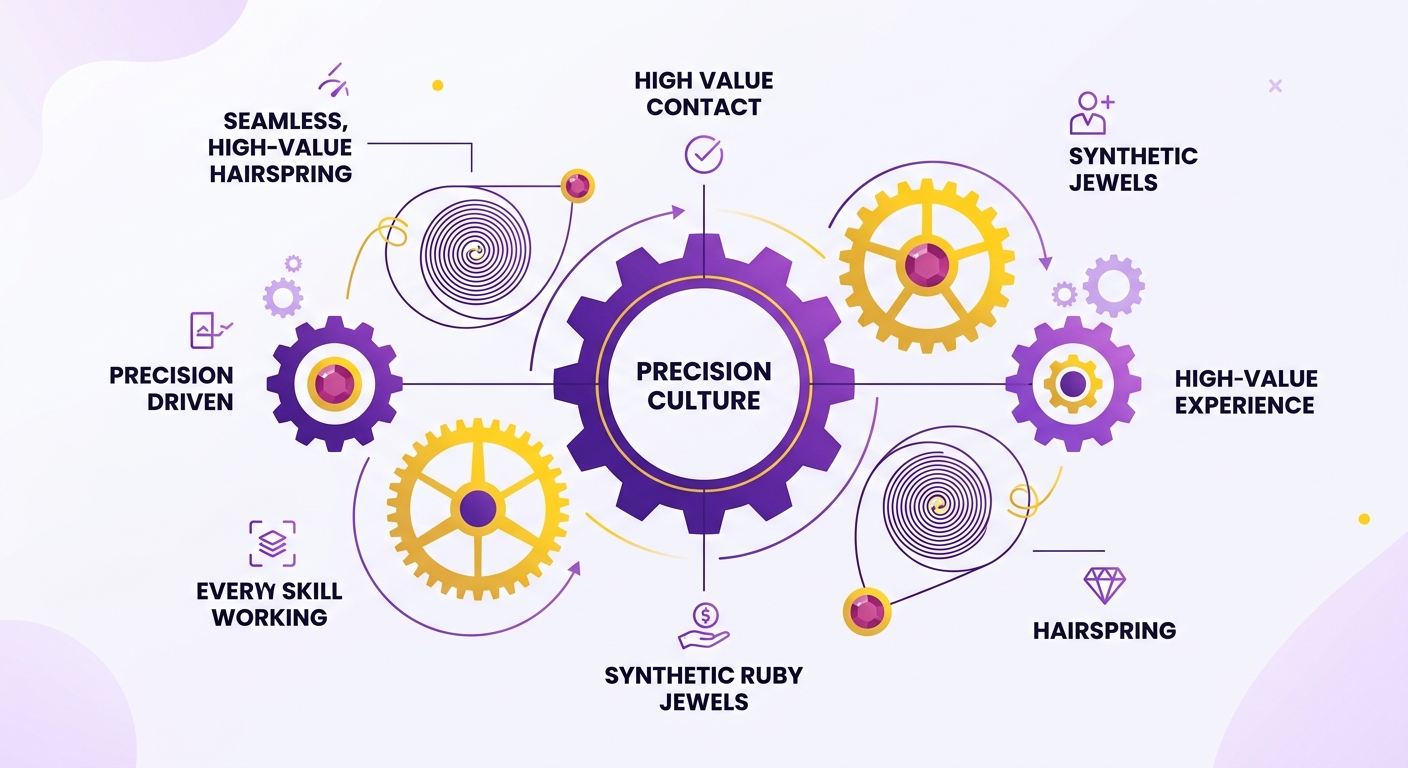
A mechanical movement reminds us that every small part must move in sync, or the whole system loses time. The same logic informs how we build editorial stories and training programs for front‑of‑house teams. Treat each brand touchpoint as a precise part of a larger narrative, and confidence can ripple through the guest experience. Some observers note that precision‑driven cultures often convey higher perceived value.
We therefore treat the editorial program itself as a movement, where each piece of content is a gear that must engage on cue. When a team nails the cadence of a welcome story, the sense of exclusivity rises, much like a balance wheel steadies its swing. Feeding audience feedback, performance metrics, and editorial checklists into the process helps each interaction land with the reliability of a well‑tuned piece.
How we build a precision‑focused editorial blueprint
We start with a clear story hierarchy, then layer timed production steps that mirror an assembly line. First, map every guest touchpoint to a content competency (e.g., a “personalized key hand‑over” maps to a “precision hand‑off” in storytelling). Next, design a short sprint for each competency, followed by a quick audit where a peer checks timing, tone, and detail against a checklist. Finally, hold a calibration meeting that compares aggregate audit scores to the visibility‑quality dashboard.
- Define the core gears – list every brand‑facing action and rank by impact.
- Create timed drills – set target durations (e.g., 45 seconds for a social teaser) and record each attempt.
- Build in instant feedback – mobile capture lets editors pause at the exact moment something slips.
- Track alignment – feed audit results into a central KPI board that shows variance from the target beat for each piece.
When a lighter approach makes more sense
If a brand generates only a handful of audience interactions per campaign, minute‑by‑minute drills may cost more than they return. In low‑volume settings, broader storytelling principles plus occasional shadowing can keep things consistent without draining resources. Reserve the full micro‑training suite for high‑traffic venues where every second of attention can translate into revenue and perception.
For a boutique operation with modest daily arrivals, a lightweight version might involve a single 45‑minute “precision welcome” workshop followed by monthly refreshers. This can help maintain guest‑satisfaction scores without overextending budget or staff.
Keeping the Ritual While Changing the Playbook
We protect signature moments—the handwritten welcome note, the bespoke interview—then layer PR tactics that personalize timing, placement, and follow‑up without stepping on the original ritual.
Planning starts with a visibility audit that reviews every brand touchpoint and aligns it with our core pillars:
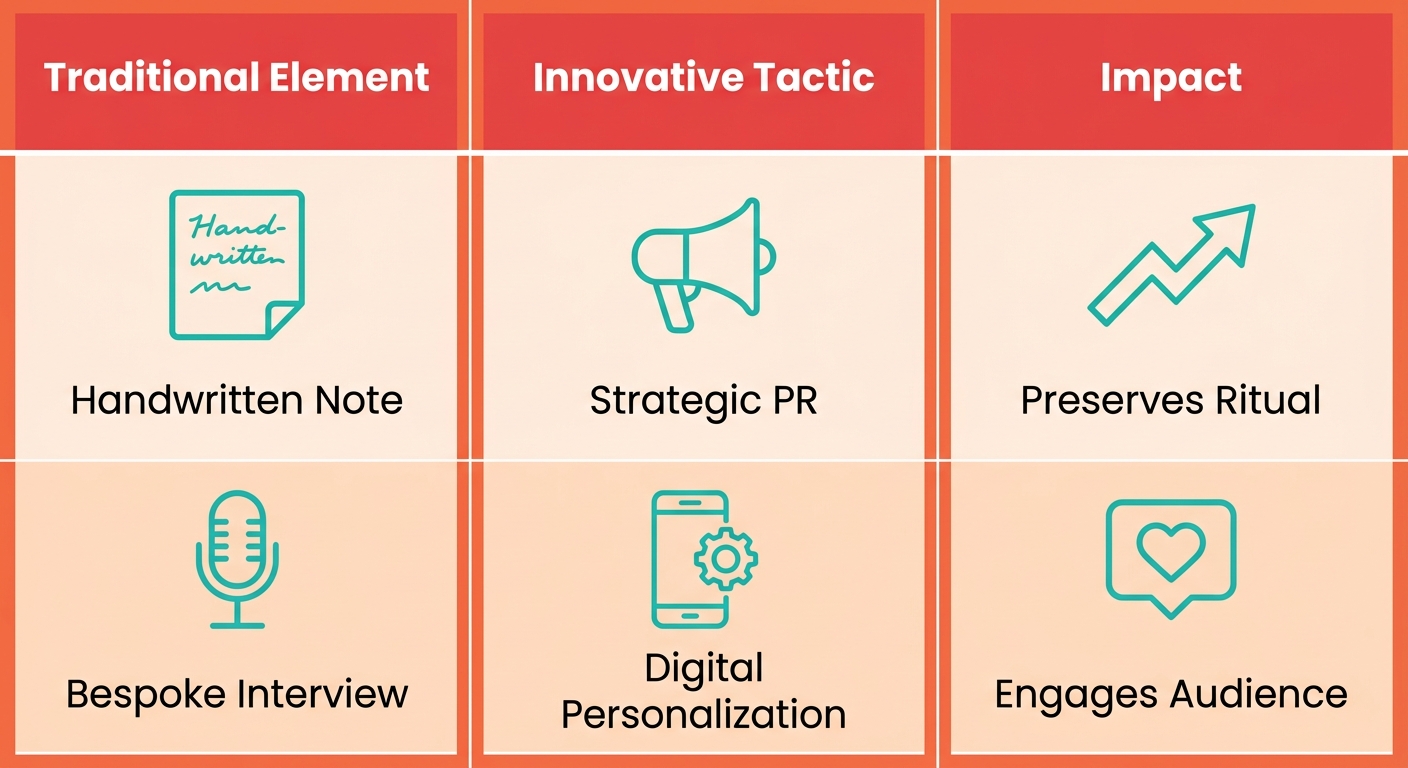
- Story development: narratives that honor a brand’s history while showing where it’s heading.
- Media placement: premium venues that match the brand’s stature and reach the right readers.
- Audience engagement: social and email that nurture relationships without diluting the message.
- Follow‑up coverage: ongoing updates that keep the story alive and relevant.
- Relationship building: connecting businesses with industry leaders through our directory and networking.
We prioritize personal interaction over pure automation in every PR effort. A thoughtful, human touch often resonates deeper than batch‑and‑blast approaches.
Which resources make the blend work?
Answer: A curated toolbox of editorial guidelines, media contacts, and staff‑training modules lets us introduce new ideas while keeping each brand’s story authentic.
- Editorial guidelines: standards for tone, visual style, and structure, ensuring every piece feels handcrafted and on‑brand.
- Media outreach playbook: proven steps for pitching, securing placement, and measuring impact across premium titles.
- Training curriculum: role‑play and workshops that rehearse the hand‑off from editorial planning to live execution, reinforcing the rhythm of trusted storytelling.
We also run quarterly innovation labs: pilot a new angle, test it with a select segment, and gauge the effect on visibility. When a pilot maintains story integrity and lifts engagement, we scale it across the campaign.
References
[1] A Game‑Changer For The Luxury Watch Industry? – EHL Insights – https://insights.ehl.edu/watch-industry
Frequently Asked Questions
1. How can a property larger than a boutique hotel adapt the escapement accuracy principle without overwhelming staff?
Escapement accuracy can be scaled by using front‑desk check‑in prompts and a standardized greeting protocol that staff practice in brief, focused sessions. Larger properties often roll out this training in phases across departments, allowing managers to monitor guest wait times and adjust workflows gradually.
2. What if my hotel experiences high staff turnover—does the power‑reserve management principle still deliver cost savings?
Power‑reserve management can remain effective despite turnover because it relies on a structured scheduling matrix rather than individual habits. By mapping peak occupancy patterns and aligning shift structures to historical demand, hotels can often reduce unnecessary overtime and optimize labor allocation even when onboarding new team members.
3. Is the complication integration step too risky for a seasonal resort that only operates six months a year?
Complication integration can be adapted for seasonal operations by piloting a single high‑impact service layer—such as a personalized arrival amenity or a specialized concierge package—during peak weeks. Compressing the implementation schedule to align with the high season allows the property to capture guest‑satisfaction gains without overcommitting resources in the off‑season.
4. How does the quick‑summary dashboard interact with existing property management systems (PMS) to monitor the five service pillars?
Dashboards can be configured to pull data from a PMS and align it with the five service pillars—check‑in timing, room‑prep consistency, added services, public‑space polish, and staffing efficiency. Managers can view a single screen that updates regularly, enabling adjustments without manual cross‑referencing.
5. Are there misconceptions that applying Swiss‑watch precision will always increase guest satisfaction, even in budget hotels?
Applying Swiss‑watch precision does not guarantee higher satisfaction in budget settings, where guests typically prioritize affordability and basic utility. For these properties, the focus should remain on core operational reliability and speed; introducing elaborate service rituals or high‑touch personalization can create unnecessary overhead that does not align with the target market’s expectations.
6. How can Industry Idols’ editorial services support the finishing polish principle for public spaces?
Industry Idols can reinforce the finishing polish principle by crafting narratives that highlight a property’s physical upgrades and sensory design elements, then sharing these stories with targeted audiences. The impact of this exposure is monitored through reader interaction trends, helping properties connect public‑space enhancements to broader brand perception and guest interest.