
Why Vizcaya Still Shapes Miami’s Eco-Luxury Design
More than a century after James Deering began building Vizcaya on Biscayne Bay, the historic Miami estate still offers lessons for a new generation of hotels, designers and hospitality brands.
By Chris Caprice | Industry Idols
Long before “eco-luxury” became part of the hospitality vocabulary, Vizcaya Museum and Gardens was already exploring many of the ideas behind it.
Shade. Airflow. Gardens integrated into architecture. Natural materials. Water. Indoor-outdoor living. A strong connection between a property and the environment surrounding it.
Built along Biscayne Bay beginning in the 1910s, Vizcaya is usually celebrated for its European-inspired architecture, elaborate interiors and formal gardens. But looking beyond the surface reveals something more relevant to modern Miami.
Vizcaya demonstrates how luxury can be created through atmosphere, movement and a sense of place.
That is what makes the estate worth studying more than 100 years later.
Luxury Designed Around Miami
Vizcaya was created as the winter estate of industrialist James Deering, with construction of the main house beginning in 1914.
Architect F. Burrall Hoffman worked on the house, while artistic director Paul Chalfin helped shape the interiors and overall visual character of the estate. Landscape architect Diego Suarez later played an important role in designing the formal gardens.
European influence is everywhere.
Italian Renaissance gardens, Mediterranean architectural references, stone terraces, fountains, sculptures and ornate rooms give Vizcaya much of its recognizable identity.
But the estate was never simply an attempt to reproduce Europe in Florida.
Its real character comes from what happened when those influences met Miami.
The property opens toward Biscayne Bay. Covered spaces create transitions between interior rooms and the outdoors. Gardens become extensions of the house. Shaded areas provide relief from direct sunlight while breezes and open-air circulation help shape the experience.
The architecture is part of the landscape rather than something completely separated from it.
That distinction remains important today.
Miami luxury works best when it feels like Miami.
The Power of Indoor-Outdoor Design
One of Vizcaya’s strongest qualities is how naturally the property moves between indoor and outdoor spaces.
Visitors rarely experience a hard separation between the building and the landscape.
A room leads toward a terrace.
A terrace opens toward a garden.
A walkway leads toward water.
A shaded passage suddenly reveals sunlight.
The experience unfolds gradually.
That type of movement is now central to many luxury hotels, resorts and residential projects throughout South Florida.
Developers frequently promote indoor-outdoor living as a modern lifestyle feature, yet Vizcaya was exploring the relationship generations ago.
The lesson is not to copy the estate.
It is to understand the principle behind it.
Outdoor spaces should not feel like leftover areas surrounding a building. They can become functional rooms of their own.
A courtyard can become a gathering place.
A garden can create privacy.
A shaded terrace can become a dining area.
A walkway can become part of the experience rather than simply a way to move from one location to another.
When those areas are intentional, the property begins to feel larger, calmer and more immersive.
The Gardens Are More Than Landscaping
The gardens at Vizcaya are among the property’s most recognizable features, but their importance goes beyond beauty.
They organize the estate.
Hedges create boundaries. Paths control movement. Water features establish focal points. Terraces change elevation and perspective. Openings reveal different views as visitors move through the grounds.
Instead of showing everything at once, the landscape creates discovery.
One area leads into another.
That sense of sequence has become increasingly valuable in hospitality design.
Today’s guests are not simply purchasing a room. Luxury properties are increasingly expected to deliver environments that can be experienced, photographed, shared and remembered.
A successful outdoor area can become a breakfast terrace in the morning, a quiet retreat in the afternoon and an event space at night.
That flexibility is part of what makes landscape design economically valuable as well as visually appealing.
Vizcaya understood the power of creating destinations within a destination.
Shade May Be One of Miami’s Greatest Luxury Features
Modern hospitality conversations often focus on technology, energy-efficient equipment and advanced building systems.
Those systems matter.
But Vizcaya reminds designers of something much simpler: buildings can also respond directly to their environment.
In Miami, shade is valuable.
Covered walkways, protected exterior spaces, deep openings and transitional areas can change how comfortable an environment feels before mechanical cooling becomes part of the equation.
That does not mean a modern Miami hotel can operate without air conditioning.
It means thoughtful architecture can reduce the amount of work technology has to do while improving the guest experience at the same time.
The strongest lesson from Vizcaya is not nostalgia.
It is responsiveness.
Design around the climate instead of pretending the climate does not exist.
Materials That Feel Connected to Place
Another lesson comes from the visual relationship between Vizcaya’s materials and South Florida.
Stone, plaster, terracotta, masonry and aged surfaces contribute to an atmosphere that feels established rather than manufactured.
Many modern properties are designed to look flawless on opening day.
The problem is that Miami is not particularly gentle with buildings.
Humidity, rain, intense sunlight and salt air can quickly expose materials selected for appearance without enough consideration for how they will age.
Vizcaya’s ongoing conservation work is also a reminder that beautiful environments require maintenance.
Historic materials are not maintenance-free.
Neither are luxury hotels.
The broader takeaway is to select materials based not only on how they look when installed, but how they will perform and age within the environment.
Sometimes the most luxurious material is the one that develops character instead of simply deteriorating.
Water Changes the Experience
Vizcaya’s fountains, pools and relationship with Biscayne Bay add another layer to the estate.
Water attracts attention naturally.
It changes sound.
It reflects light.
It creates movement.
And psychologically, particularly in a hot climate, water can make an environment feel cooler and calmer.
Modern resorts understand this well.
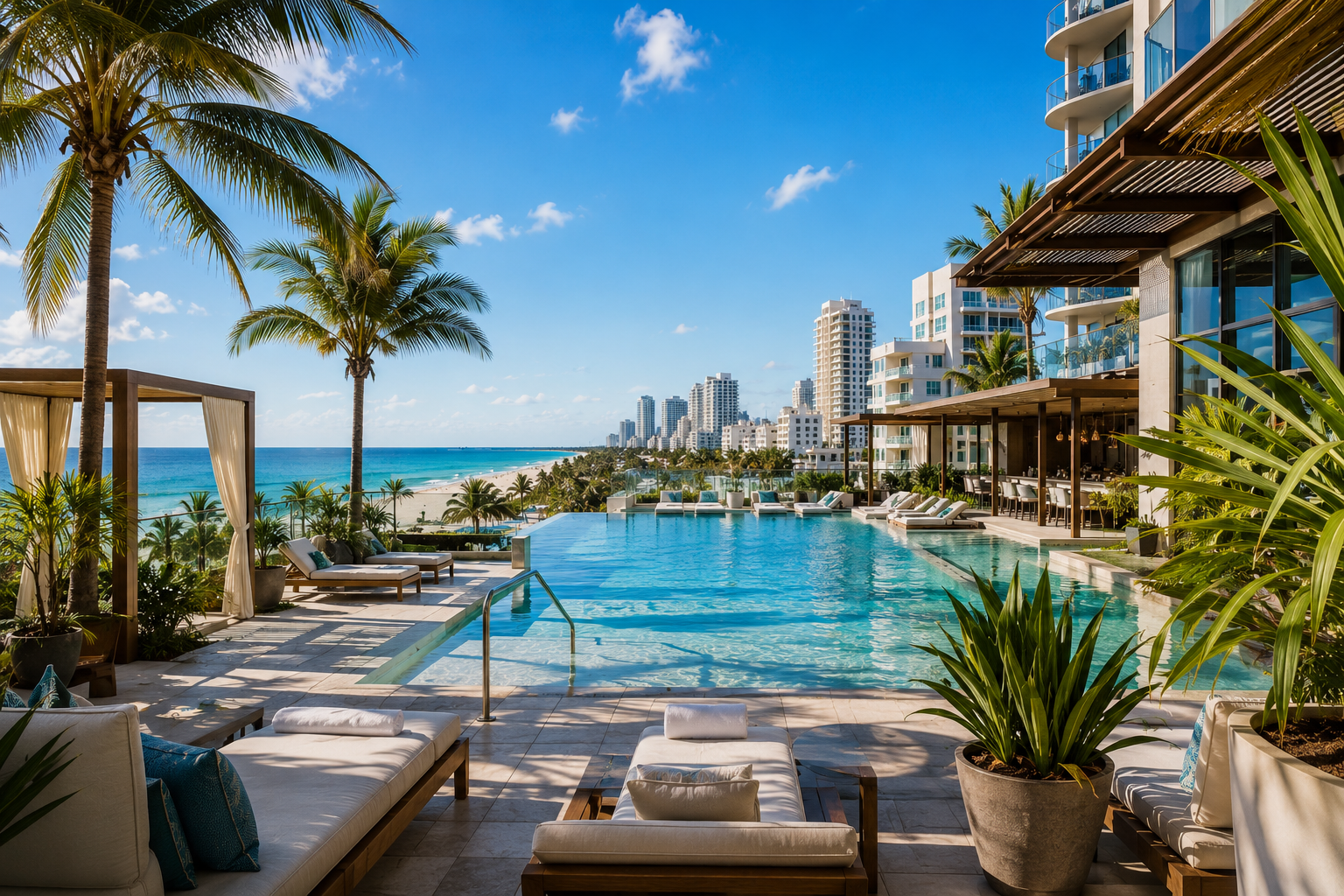
Pools, fountains, reflecting areas and waterfront views have become defining features of hospitality design.
But there is an important distinction between using water intentionally and adding it simply because it looks expensive.
Every design feature eventually becomes an operational responsibility.
Water requires maintenance, circulation, cleaning and ongoing cost.
The strongest examples earn their place by improving the environment around them.
That is the better lesson to take from Vizcaya.
Why Boutique Hotels Should Pay Attention
A boutique hotel obviously cannot recreate a 43-acre historic estate.
It should not try.
The opportunity is to take the principles that scale.
A smaller property can still create a shaded courtyard.
It can create an intentional transition from lobby to garden.
It can use materials connected to the region.
It can frame a view rather than filling every space with decoration.
It can create one memorable water feature instead of five unnecessary ones.
It can design exterior areas as actual destinations.
Most importantly, it can build a strong relationship between architecture and location.
That relationship creates something marketing departments spend enormous amounts of money trying to manufacture later:
identity.
The Difference Between Design and Decoration
Miami has no shortage of beautiful hotels.
But beauty alone does not create a memorable property.
There is a difference between decoration and design.
Decoration changes how something looks.
Design changes how something works and feels.
Vizcaya remains compelling because the experience is not dependent on one chandelier, one fountain or one room.
It comes from the relationship between everything.
Architecture.
Landscape.
Water.
Light.
Shade.
Views.
Movement.
History.
That is considerably harder to imitate than a Mediterranean color palette.
A hotel that borrows arches, stone and terracotta without understanding the relationship between those elements risks creating a theme.
A property that studies how people move, gather, cool down, transition and discover spaces is learning something much more valuable.
Where the Vizcaya Blueprint Doesn’t Work
Not every property should look to Vizcaya.
A downtown high-rise has completely different limitations than a low-rise waterfront hotel.
A property designed around speed, business travel and convenience may not benefit from long landscaped transitions.
A hotel without significant outdoor space cannot reproduce the estate’s garden-driven experience.
Trying to force the aesthetic into the wrong building can quickly become artificial.
That is why the smartest lesson is not to reproduce Vizcaya’s appearance.
It is to understand its relationship with its site.
Every property should ask its own version of the same questions.
Where does the sunlight hit?
Where does the breeze move?
Where will guests naturally gather?
Where should they slow down?
What should they see when they enter?
What materials belong here?
How can the landscape become part of the experience?
Those questions are more useful than copying any architectural style.
Preservation Is Part of Luxury
Vizcaya also offers a lesson that rarely appears in development renderings.
Buildings age.
Luxury requires maintenance.
Vizcaya’s preservation and conservation programs continually address the effects of climate, moisture, materials and time.
Modern hospitality operators face their own version of that challenge.
A property near the water must prepare for salt exposure.
Landscaping requires maintenance.
Exterior materials require care.
Water features require servicing.
Historic-looking finishes do not eliminate modern operational realities.
True luxury is not simply creating something beautiful.
It is maintaining the experience after opening day.
Why Vizcaya Still Matters
Miami is changing rapidly.
New hotels, condominiums, restaurants and lifestyle concepts continue reshaping neighborhoods throughout South Florida.
Many of those projects are searching for the same thing:
a sense of place.
That search is what makes Vizcaya relevant.
The estate represents an era when architecture, landscape and location were treated as parts of the same experience.
More than a century later, those ideas feel surprisingly modern.
The future of luxury hospitality may involve smarter technology, better energy systems and increasingly sophisticated buildings.
But some of the strongest design principles remain remarkably simple.
Create shade.
Encourage airflow.
Respect the landscape.
Use materials thoughtfully.
Design outdoor spaces with purpose.
Give people somewhere worth slowing down.
And build something that could only belong where it stands.
Vizcaya achieved that long before Miami became an international luxury destination.
That may be its most important legacy.
It is not simply one of Miami’s most beautiful historic properties.
It is a reminder that the strongest luxury design does not fight its surroundings.
It belongs to them.
Visiting Vizcaya Museum and Gardens
Vizcaya Museum and Gardens is located in Miami along Biscayne Bay.
Visitors interested in architecture and design should consider experiencing the main house and gardens together. The relationship between the two is essential to understanding the estate.
Rather than focusing only on individual rooms or decorative objects, pay attention to the transitions.
Notice where shade begins.
Notice how views are framed.
Look at where people naturally stop.
Watch how the gardens reveal themselves gradually instead of all at once.
And pay attention to the relationship between the house, the landscape and the bay.
That is where the real design story lives.
Frequently Asked Questions
Why is Vizcaya important to Miami architecture?
Vizcaya combines European architectural and landscape influences with a property designed around South Florida’s environment and Biscayne Bay. Its relationship between architecture, gardens and outdoor living helped create one of Miami’s most recognizable historic estates.
When was Vizcaya built?
Construction of Vizcaya’s main house began in 1914 for businessman James Deering. Development of the larger estate continued during the following years.
Who designed Vizcaya?
Architect F. Burrall Hoffman designed the main house, while Paul Chalfin played a major role in the estate’s artistic direction and interiors. Landscape architect Diego Suarez contributed significantly to the design of Vizcaya’s formal gardens.
Why are Vizcaya’s gardens important?
The gardens function as extensions of the architecture. Paths, hedges, terraces, water features and framed views create a sequence of outdoor spaces rather than simply decorative landscaping.
What can modern hotels learn from Vizcaya?
The most transferable lessons include purposeful outdoor spaces, shade, connection to climate, regional materials, thoughtful transitions between spaces and designing around the specific character of a location.
Is Vizcaya an example of sustainable architecture?
Vizcaya predates today’s sustainability standards and certifications, so it should not be described as a modern sustainable building in the technical sense. However, several aspects of the estate demonstrate climate-responsive design principles that remain relevant today.
Sources
Vizcaya Museum and Gardens
https://vizcaya.org/
Vizcaya Main House
https://vizcaya.org/main-house/
Vizcaya Preservation & Conservation
https://vizcaya.org/category/preservation-conservation/
National Endowment for the Humanities — Vizcaya’s Gilded Age History
https://www.nehforall.org/projects/a-gilded-age-mansion-and-its-treasures-in-miami
Greater Miami Convention & Visitors Bureau — Vizcaya Museum and Gardens
https://www.miamiandbeaches.com/l/attractions/vizcaya-museum-and-gardens/2025