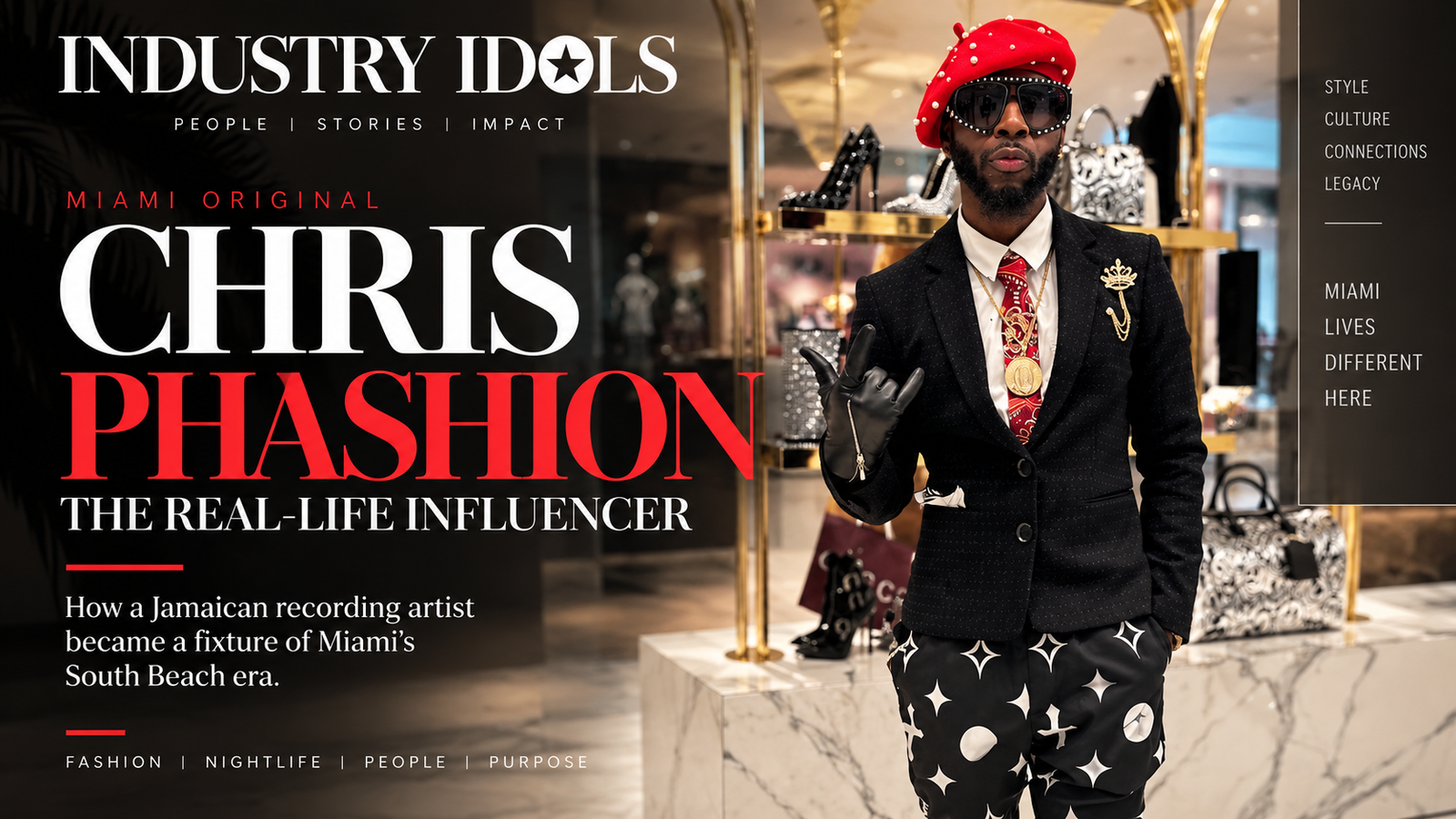
Long before influence was measured in followers, Chris Phashion was building his name through fashion, nightlife, relationships and an unmistakable presence in Miami.
By Chris Caprice | Industry Idols
Before there was Chris Phashion, there was simply Chris.
A young Jamaican recording artist with ambitions of making it in music, he could not have known that his path would eventually lead him into a completely different world, one that would place him inside Miami’s evolving nightlife, fashion and entertainment culture.
“There was never any Chris Phashion,” he told Industry Idols. “There was just a Chris. I had to figure it out.”
That process started long before Miami.
Growing up in Jamaica, Phashion says individuality was already part of his identity. As a young recording artist, clothing wasn’t simply something he bought off a rack. He remembers choosing fabrics, working with tailors and helping design distinctive looks that separated him from everyone else.
“I’ve always wanted to be different,” he says.
Sometimes, being different came with ridicule.
Phashion remembers people questioning his unconventional clothing and wondering why he refused to dress like everyone around him. Instead of changing, he leaned further into his individuality.
What he couldn’t have known was that those experiences were preparing him for an entirely different stage.
From Jamaica to New York to South Florida
Phashion says he recorded his first music in Jamaica as a teenager before getting an opportunity to move to New York around age 20.
His original plan was music.
America, he thought, would provide the opportunity to promote his records and become the artist he imagined himself becoming.
Life took him in another direction.
After several years in New York, Phashion relocated to South Florida in 1995. Fort Lauderdale initially felt more familiar. The climate was warmer, Caribbean culture was present, and he continued pursuing music while staying connected to the dancehall world he knew.
Then he discovered South Beach.
And everything changed.
Around 1999, Phashion remembers venturing south from Broward and encountering a world completely different from the one he knew.
The music was different.
The clubs were different.
The fashion was different.
So were the people.
Instead of trying to blend in, he eventually made a decision that would define his identity.
If people were going to look at him, he would give them something worth looking at.
“I said, ‘I’m a fashion statement.’”
Becoming Chris Phashion
Cowboy hats. Feathers. Western influences. Unexpected combinations.
Phashion began experimenting aggressively with his appearance.
The objective wasn’t to wear the most expensive outfit in the room. It was to create something nobody else in the room could duplicate.
Then came a defining moment.
Phashion remembers attending an early Miami fashion event near Nikki Beach wearing one of his unconventional looks. As he entered the tent, a photographer noticed him.
The photographer initially thought he was a celebrity.
One camera turned toward him.
Then another.
Soon, according to Phashion, photographers were surrounding him while the fashion show continued nearby.
For someone who had spent years being laughed at for dressing differently, suddenly the exact quality that made him an outsider had become his advantage.
“That was the first time that ever happened to me,” he recalls.
As his presence around South Beach grew, people began referring to him as “the fashion guy.”
But that wasn’t enough.
He wanted an identity that belonged entirely to him.
So he changed the spelling.
Fashion became Phashion.
He describes the “PH” as representing balance, eventually positioning himself as the “pH balance of fashion and lifestyle.”
Chris Phashion was born.
Influence Before Instagram
Today, building influence can begin with a phone.
For Phashion, it happened in physical rooms.
“You have to be on the scene to be seen.”
That became one of the principles behind his approach to business, entertainment and relationships.
As he became increasingly recognizable, Phashion says club owners began inviting him into venues because his personality itself had become part of the experience.
People wanted to know what he would wear.
They wanted to see him dance.
They wanted to be around the personalities surrounding him.
Phashion also began building relationships with women interested in modeling and entertainment, eventually organizing models under a management concept he called Team 7.
That network became valuable.
Models wanted access to events. Venues wanted crowds. Entertainers wanted energy around them.
Phashion positioned himself in the middle.
He doesn’t describe himself simply as a club promoter.
The modern term might be influencer, but social media had not yet transformed that word into a profession.
Phashion prefers another description.
A real-life influencer.
“I’m a real-life influencer,” he says. “Not social media.”
His influence, he explains, came from being physically present, building relationships, introducing people and creating an atmosphere.
That philosophy produced another line that still defines his approach:
“Network to create your net worth for your next work.”
For Phashion, networking was never supposed to mean simply collecting names or shaking hands.
It meant creating relationships capable of producing future opportunities.
Inside Miami’s Celebrity Era
As his visibility increased, Phashion says he found himself moving through a South Beach nightlife world populated by major figures in entertainment.
He recalls dancing and entertaining around celebrities, becoming recognizable among club owners and personalities, and gaining access to venues throughout Miami Beach.
One encounter remains particularly vivid.
Phashion recalls dancing inside a club when security suddenly approached him.
At first, he thought he had done something wrong.
Instead, he says, the security guard pointed toward the VIP area.
According to Phashion, Paris Hilton had noticed him from across the club and requested that security bring him to her section.
“I want your energy beside me,” he remembers her telling him.
For Phashion, the significance wasn’t simply being invited into a celebrity VIP section.
It represented how far his decision to embrace individuality had carried him.
The person who had once been mocked for looking different was now being noticed precisely because he refused to look like everyone else.
During his conversation with Industry Idols, Phashion recalled other moments from that era involving entertainers, fashion figures, nightlife personalities and Miami venues. Some of those stories live largely through his memories of an era that existed before Instagram, smartphones and constant social documentation.
But celebrity proximity isn’t the part of the story he considers most important today.
The relationships are.
The Connector
Ask Phashion what role he plays in Miami today and one word continually comes up:
Connector.
“I am known as the plug because I connect everyone with everything,” he says.
His definition of influence isn’t ownership.
He doesn’t need to own every project he touches or take credit for everyone he encounters.
Instead, he describes a career spent introducing people, mentoring emerging personalities, supporting promoters and helping others find their place inside Miami’s entertainment ecosystem.
Among the people he discussed with Industry Idols is longtime Miami nightlife personality Simply Jess, whom Phashion says began as one of his models before developing her own prominent career in nightlife and promotions.
He also describes years of relationships with venue owners, promoters, models and entrepreneurs who eventually developed businesses and careers of their own.
That is where Phashion believes his influence is most visible.
Not necessarily in a logo.
Not in a follower count.
But in people.
From Being Seen to Helping Others Be Seen
More than two decades after first discovering South Beach, Phashion’s priorities have evolved.
The personality hasn’t disappeared.
Neither has the fashion.
But the mission has matured.
“I have walked my walk already,” he says.
Now, Phashion says he is increasingly interested in recognizing people who possess the hunger and passion he once carried and helping them navigate an industry he has watched transform around him.
Miami nightlife itself has changed.
The cultural center expanded beyond South Beach into areas including Wynwood and Brickell, while South Florida’s entertainment ecosystem continued growing throughout Miami-Dade and Broward.
Social media changed how personalities become known.
Technology changed networking.
The definition of celebrity changed.
But Phashion believes certain fundamentals remain.
Relationships matter.
Presence matters.
Individuality matters.
And confidence matters.
When he encounters younger entrepreneurs, creatives or entertainment professionals with genuine passion, he says he feels a responsibility to help.
“I see that they have this love and passion for the industry,” he says. “It immediately makes me gravitate towards them and make me want to help them. Because I’ve done it. I’ve been there.”
For Phashion, preserving and sharing that knowledge has become part of his purpose.
Confidence, Purpose and the Next Generation
At the end of his conversation with Industry Idols, Phashion was asked to leave the next generation with one piece of advice.
His answer wasn’t about fashion.
It wasn’t about celebrities.
It wasn’t even about networking.
It was about confidence.
“Confidence with not just who you are, but whose you are,” he says.
His faith is now inseparable from the way he understands his journey.
The ridicule.
The music career that didn’t unfold as originally imagined.
Jamaica.
New York.
Fort Lauderdale.
South Beach.
The unconventional outfits.
The cameras.
The relationships.
The rooms he eventually entered.
Looking backward, Phashion sees those experiences not as disconnected chapters, but as preparation.
He encourages people to stop allowing outside opinions to determine their identity.
“Tone out and tune out the noise and the negative frequency,” he says. “Tune in to your own frequency, your own divine existence. Get that confidence and make a move.”
It is fitting advice from someone whose identity was created by refusing to disappear into the crowd.
Before followers, likes and algorithms transformed influence into a measurable commodity, Chris Phashion built his reputation the old-fashioned way.
He showed up.
He stood out.
He connected people.
And more than two decades later, he is still on the scene.
Only now, the goal isn’t simply to be seen.
It’s helping the next generation find its own spotlight.