Inside Frost Science: Why Miami’s Interactive Museum Is More Than an Aquarium
By Chris Caprice | Industry Idols
Miami has no shortage of attractions competing for attention. Beaches, nightlife, restaurants and major events dominate the conversation.
But tucked into Downtown Miami’s waterfront Museum Park is an experience built around something different: curiosity.
The Phillip and Patricia Frost Museum of Science brings an aquarium, planetarium and interactive science museum together under one roof, creating one of Miami’s more distinctive family and cultural destinations.
And the best part of Frost Science may be that you don’t simply walk through it.
You interact with it.
A Different Kind of Miami Experience
Frost Science is designed around exploration.
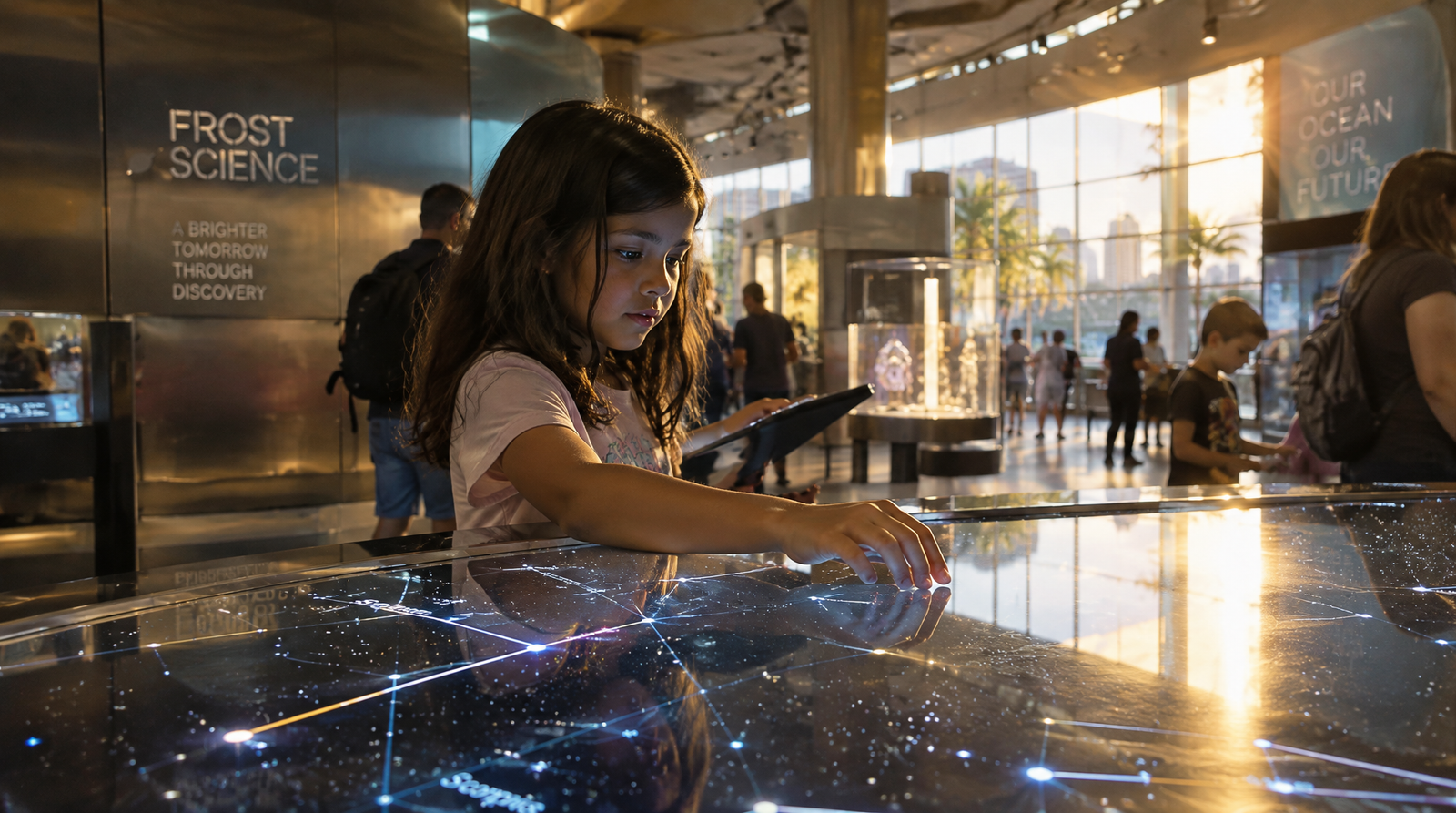
Instead of building the entire experience around traditional museum displays, many of its spaces encourage visitors to touch, move, experiment and see scientific concepts play out in front of them.
That makes the museum especially appealing for families, but it doesn’t necessarily feel like an attraction made only for children.
There are marine environments, human biology exhibits, technology-driven installations and immersive space programming, all layered into the same building.
For visitors, that variety is what gives Frost Science its advantage.
You can spend one part of the afternoon looking into a massive aquarium habitat and another sitting beneath a planetarium dome exploring space.
The Aquarium Is the Centerpiece
For many visitors, the aquarium alone will be the reason to go.
Rather than presenting marine life through one long gallery of tanks, Frost Science creates a multi-level journey through different aquatic environments.
Visitors move through the experience from different perspectives, eventually reaching some of the museum’s most impressive underwater viewing areas.
The result feels less like walking through an aquarium hallway and more like exploring an ecosystem from multiple levels.
It also gives Frost Science something important in Miami: an attraction that connects directly to South Florida’s relationship with the ocean.
Marine life, conservation and environmental science aren’t abstract subjects here. They are part of the region surrounding the museum.
Then You Leave the Ocean for Space
The Frost Planetarium changes the scale completely.
Inside the dome, astronomy and visual programming surround the audience, turning what could have been a traditional educational presentation into a much more immersive experience.
Programming can vary, so checking the museum’s current schedule before visiting is important.
But pairing a planetarium with an aquarium is part of what makes Frost Science unusual.
Within the same visit, you can move from marine ecosystems below the surface of the ocean to a presentation about objects millions of miles beyond Earth.
Science You Can Actually Touch
Some of Frost Science’s most interesting areas are smaller interactive exhibits that sit between those two major attractions.
MeLaβ explores the human body through interactive experiences designed to make biology personal.
River of Grass brings the Everglades into the museum, helping visitors understand how water, wildlife and South Florida’s ecosystem connect.
Feathers to the Stars explores humanity’s fascination with flight, connecting natural flight with aviation and eventually space exploration.
These exhibits matter because they turn subjects that can feel academic into something visitors can actually experience.
Instead of simply reading about how something works, you are encouraged to participate.
That distinction is particularly important when children are involved.
A touchscreen, physical challenge, projected environment or live demonstration can sometimes explain in seconds what a paragraph on a museum wall cannot.
The Everglades Story Belongs Here
One of the smartest things Frost Science can do is use its Miami location as part of the experience.
South Florida sits beside one of the most unusual ecosystems in the world.
The Everglades influences the region’s water, wildlife and environmental future, yet millions of people living in or visiting Miami may never fully understand how interconnected that system is.
River of Grass gives the museum an opportunity to translate that complicated ecosystem into something easier to visualize.
That makes Frost Science more than another science museum that could exist in any American city.
Its strongest exhibits have a reason to exist specifically in South Florida.
It’s Not a Dinosaur Museum
This is also where expectations matter.
If your idea of a science museum revolves around enormous dinosaur skeletons and extensive fossil collections, Frost Science may not be the destination you’re imagining.
Its strengths are elsewhere.
The museum leans more heavily into marine science, ecosystems, human biology, technology, space and interactive learning.
That isn’t necessarily a weakness.
It simply means you should know what you’re buying a ticket for.
Frost Science works best when visitors embrace what the museum actually does well instead of expecting it to imitate larger natural-history museums.
Why Adults Shouldn’t Automatically Skip It
Calling Frost Science a family attraction is accurate.
Calling it only a children’s attraction undersells it.
Adults interested in marine life, astronomy, environmental science, technology or interactive design can find plenty to explore.
The museum has also used after-hours programming to shift the atmosphere toward an adult audience, showing how dramatically the same environment can change when lighting, music and social programming enter the equation.
That introduces another side of Frost Science.
During the day, it is an educational institution.
At night, the building can become an event environment.
That crossover between culture, education and entertainment is particularly suited to Miami.
The Business Behind the Experience
There is another layer that Industry Idols finds particularly interesting.
Experiences like Frost Science don’t operate on exhibits alone.
Aquarium systems require ongoing care. Interactive installations require maintenance. Digital displays need content. Planetarium programming changes. Events need production. Exhibitions need marketing.
Behind a cultural institution of this scale sits an ecosystem of designers, engineers, technicians, content creators, marketers and production professionals.
Not every vendor relationship is publicly visible, and specific companies shouldn’t be credited without confirmation.
But the larger business opportunity is worth recognizing.
Major cultural institutions create demand for the same creative and technical industries that power Miami’s hotels, events, nightlife venues and entertainment businesses.
That means museums aren’t isolated from Miami’s creative economy.
They are part of it.
Is Frost Science Worth Visiting?
For the right visitor, yes.
Families with curious children will probably get the most obvious value from it, particularly if they take advantage of the aquarium, planetarium and interactive exhibits instead of rushing through the building.
It also works well for tourists looking for something beyond Miami’s beaches and nightlife, especially when weather makes an indoor attraction appealing.
Adults interested in marine science, space or interactive experiences can enjoy it too.
The key is giving yourself enough time.
This isn’t an attraction that makes much sense to race through.
Check the current exhibitions and planetarium schedule before arriving, determine what your group actually wants to see, and build the visit around those experiences.
The Industry Idols Take
Frost Science represents a side of Miami that sometimes gets overshadowed.
Miami is known globally for beaches, nightlife, luxury, fashion and entertainment.
But the city is also building an increasingly diverse cultural ecosystem.
Frost Science sits directly inside that evolution.
It combines education with technology, conservation with entertainment and science with experiential design.
Come for the aquarium.
Look up at the universe inside the planetarium.
Play with the exhibits.
But also pay attention to the experience being built around you.
Because some of Miami’s most interesting stories aren’t only about the people standing in the spotlight.
They’re about the people, technology and ideas creating the experience in the first place.
Industry Idols covers the people, businesses, experiences and cultural movements shaping Miami and South Florida.