

Key Takeaways
- AI speeds up the grunt work of marketing, like research and drafting, but strategic direction, brand voice, and editorial trust still belong to human judgment.
- The global AI-in-marketing market grew from roughly $15.84 billion in 2021 and is projected to pass $107.5 billion by 2028.
- Marketers using AI-assisted SEO recorded 34% higher improvement in organic ranking velocity than manual approaches.
- First-draft press releases and feature pieces that once took days can now be produced in hours with AI support.
- AI earns its keep in audience research, pitch personalization, media monitoring, editorial angle generation, and first-draft content.
- Media list building and background research move faster with AI, so teams ship pitches sooner than manual methods allowed.
- Premium brands in hospitality, entertainment, beauty, fashion, and luxury lifestyle treat AI as an accelerator for judgment, not a replacement for it.
Quick Summary
AI has turned marketing leadership from a manual, reactive job into a faster, sharper, and far more measurable visibility engine. It speeds up research, tightens targeting, drafts content, and streamlines campaigns. But human judgment still owns the parts that matter most to premium brands: credibility, brand voice, and editorial trust.
Here’s the verdict up front. In our experience with high-end consumer sectors, AI raises the bar because it compresses the grunt work. It does not replace strategic direction. The teams winning premium clients treat AI as an accelerator for judgment, not a substitute for it.
Where AI Actually Earns Its Keep
AI’s real value in premium visibility work sits in automating the early stages of a campaign, which frees teams to focus on positioning.
The numbers back the shift. Research in this AI-driven digital marketing study shows early adopters securing search visibility faster than competitors leaning only on traditional methods.
The upside is concrete:
- Rapid iteration: generating multiple angles for different target demographics.
- Automated monitoring: tracking brand mentions and sentiment in real time.
- Sharper message testing through automated A/B copy, per this generative AI in advertising review.
- Stronger campaign consistency across channels.
The payoff scales with integration. Companies leading in AI transformation hit six times faster median revenue growth on only 1.5 times more spend, according to this analysis of AI-driven teams.
What Still Needs a Human Hand
Judgment is the scarce skill now. As AI commoditizes execution speed, decision quality and workflow design become the defensible edge. Speed is cheap. Taste is not.
Our take: the winning personalization play for premium brands inverts the industry default. One generative-AI study argues for maximizing data to tailor every message. But research on UK marketing leaders and brand trust makes the case for data minimisation and transparency. Data-heavy personalization wins short-term conversion. Restraint wins durable trust. For luxury brands where trust is the product, we side with restraint.
Harvard’s marketing faculty put it well in this piece on AI’s future:
“Your job will not be taken by AI. It will be taken by a person who knows how to use AI.”
The Main Risk: Polish Is the Product
Flag this clearly. Low-quality AI output damages trust, and lifestyle and hospitality brands live or die on polish and authenticity. A generic, obviously machine-written press release reads as a shortcut, and premium audiences notice instantly.
One line from the study on AI teams sums up the trap:
“If your marketing function is disjointed, AI won’t fix it. It will expose it.”
So skip AI for final editorial copy, where your brand voice carries the credibility. Use it for research, drafts, and testing. Keep a human editor on anything a customer will read as your voice.
A full at-a-glance comparison of AI-assisted marketing, PR agencies, generic content tools, and human-led strategy sits toward the end of this article.
Why AI Is Raising the Bar for Marketing Leaders
The pressure on marketing leaders right now isn’t about producing more content. It’s about producing the right content, for the right person, faster than the market moves. Across premium sectors like hospitality, entertainment, and luxury lifestyle, generic messaging isn’t just weak. It actively erodes the perception you sell.
That’s the real stakes here. When brand perception is the product, a mistargeted campaign does more than waste budget. It cheapens the name. AI raises the bar because it lets you get relevance right at speed, and it punishes teams that were leaning on volume to hide sloppy targeting.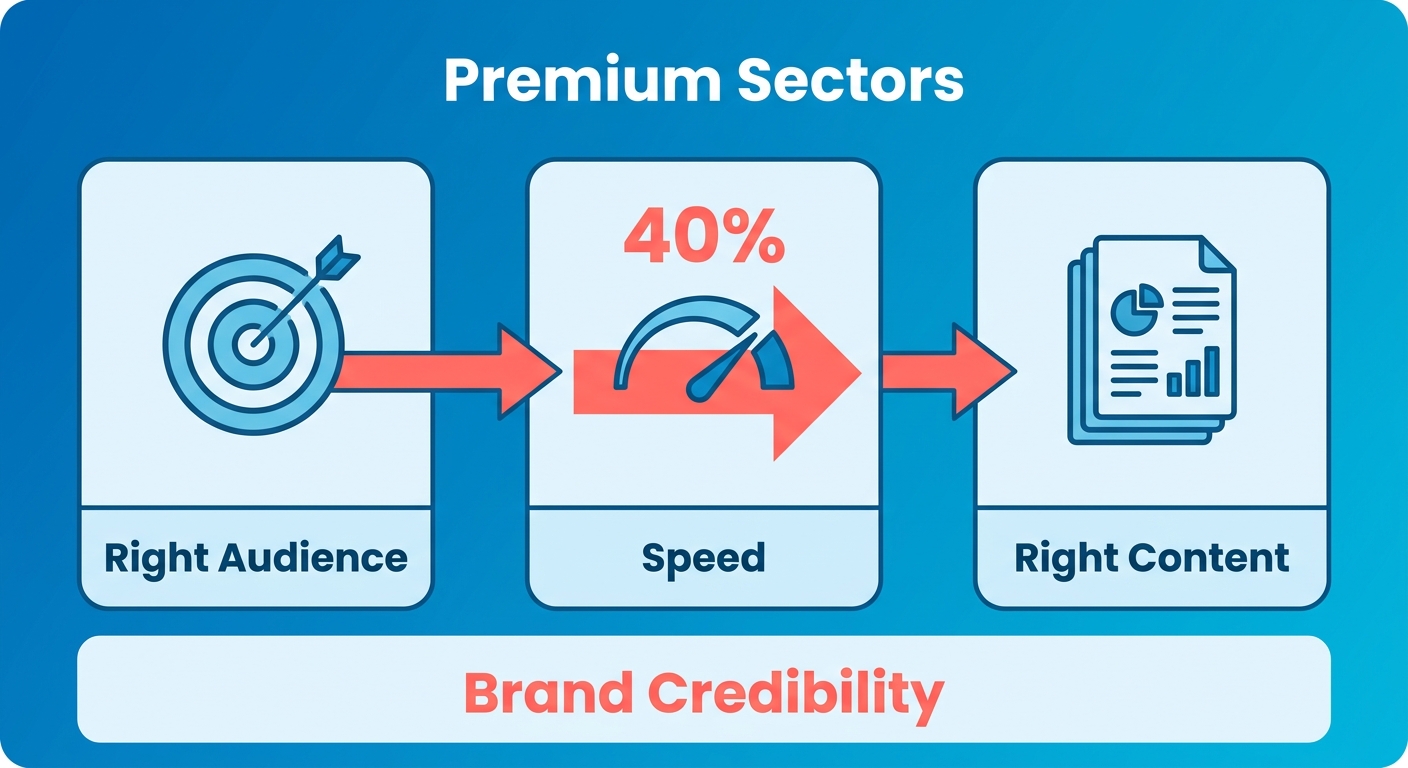
Why Precision Replaced Mass Messaging
The shift is from broadcasting to precision visibility. Companies that excel at personalization generate 40% more revenue from those activities than average players, per McKinsey figures cited in this research. Starbucks tailors app offers around individual behavior, and Netflix recommends with enough precision to keep people watching.
Here’s where premium brands should tread carefully. Mass-market campaigns lean on heavy data tracking, but high-end consumers expect discretion. The UK brand-trust research shows consumers respond better to brands that respect their digital boundaries. For premium positioning, that means chasing contextual relevance rather than tracking every user action across the web.
What’s Actually Changing About the Leader’s Job
The job is moving from managing production to designing systems and making sharper calls. AI can cut campaign execution from four weeks to four days, and agentic AI is set to absorb more than a fifth of marketing’s workload within two to three years.
As those timelines shrink, leaders shift from managing output volume to auditing whether campaigns are strategically aligned. The value is in setting the parameters that guide the automated systems.
Where the value lands tells the story. Marketing and sales rank among the functions where generative AI could add between $1.4 trillion and $2.6 trillion, but that upside concentrates in teams with coherent processes. Without a unified operating framework, automation just accelerates the inefficiencies you already had.
Is the Real Bottleneck Talent or Enablement?
It’s enablement, not hiring. Marketing leaders are more optimistic about finding AI talent than their C-suite peers. Yet a survey of over 1,500 marketers shows employee adoption lagging despite record investment.
Two different problems. You can recruit specialists while your existing team stalls. The priority is upskilling the people you already have so they fold these tools into their daily routines. Fix the internal skills gap first: make sure the team knows how to prompt, edit, and audit what the AI hands back.
This article is intended for editorial and informational purposes only.
AI vs Traditional PR Agencies and Generic Content Tools
None of these three models wins outright. AI wins on speed and iteration, PR agencies win on relationships and editorial judgment, and generic content tools mostly win on volume. For high-end brands, the mistake we see most is treating them as interchangeable when they solve different problems.
In our experience managing high-end lifestyle accounts, automation lets teams shift focus. Instead of hours on manual distribution or basic formatting, marketers put their energy into refining the creative angles that resonate with sophisticated audiences.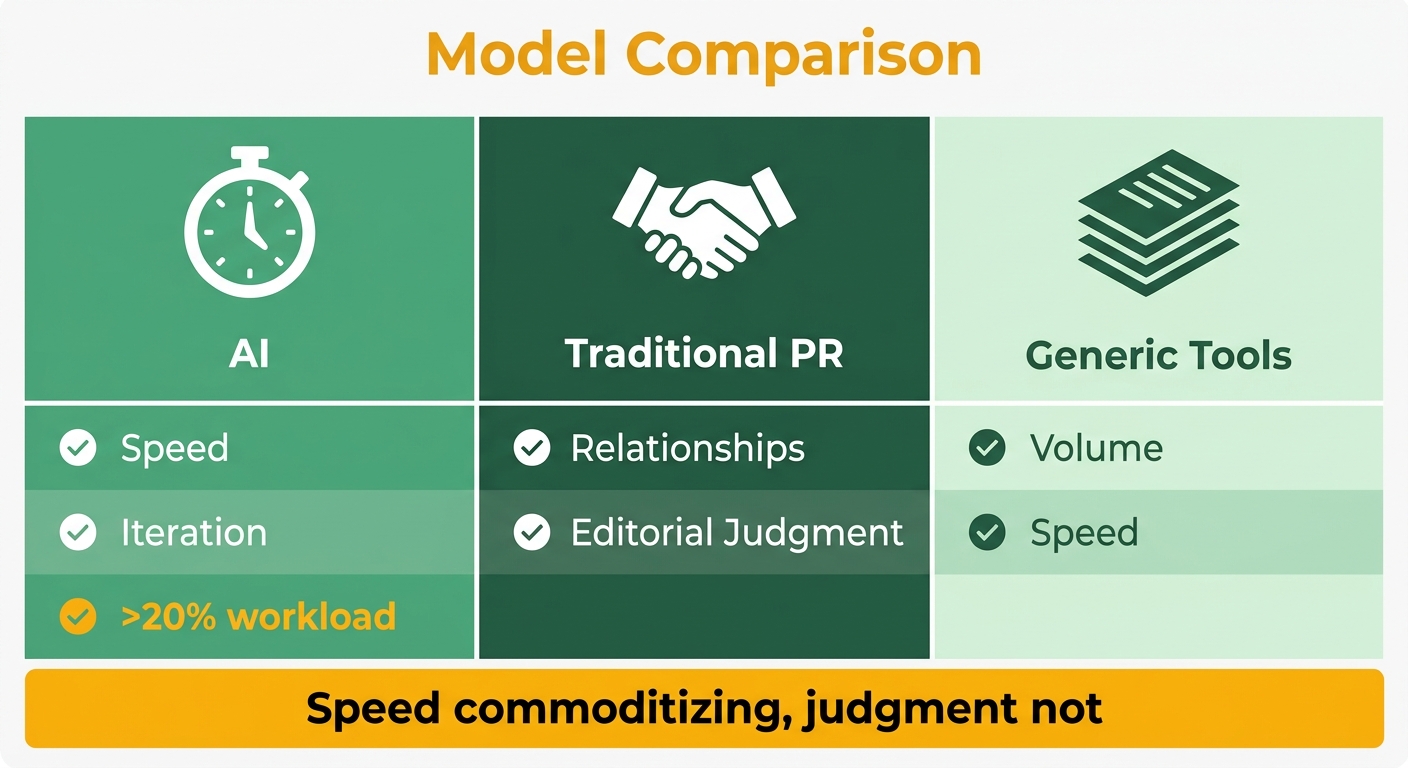
What Generic Content Tools Get Wrong
Generic tools give you output at scale with weak differentiation. Fine for volume tasks. It fails badly when tone and specificity are the whole product, which is exactly the case for a premium watch or a five-star property.
The research is blunt about the trap. The AI-Driven Digital Marketing paper notes that marketers who bolt on AI reactively get inferior results, while those treating it as part of a deliberate strategy see meaningfully stronger engagement. Generic tools nudge you toward reactive use by default, because they optimize for throughput rather than positioning.
Skip generic tools entirely for your flagship narrative work. Use them for internal drafts, reformatting, and first-pass research. Never for the pitch that lands a heritage brand in a national outlet.
Where PR Agencies Still Beat AI
Media relationships, editorial context, and reputation management stay human-led. No model has a warm contact at an editor’s desk. No model carries the accountability when a story goes sideways.
This is where the research gets interesting. BCG argues AI shifts accountability away from agencies toward technology, while the AI-Driven Digital Marketing paper insists strategic human competency is what enables ROI in the first place. Both are right about different layers. Technology absorbs the work. Humans absorb the accountability. In practice, AI doesn’t replace your agency by writing better copy. It replaces agency dependence with in-house strategic direction over AI systems.
What a Hybrid Workflow Looks Like
The hybrid setup: AI drafts, a strategist refines, and a PR lead finalizes the pitch or release before it reaches a journalist.
That sequence matters. AI handles research and the messy first draft. Your strategist enforces brand voice and specificity. Your PR lead applies editorial judgment and the relationship read no tool has. IMD calls AI a strategic foundation, not a strategy itself, and that gap is exactly where the human roles sit.
One warning from the field: automation applied to a broken process only accelerates the chaos. Design the workflow first. The teams winning premium accounts treat these models as tools that support the specialists who hold key media relationships, not replace them.
AI-Assisted Audience Research and Message Strategy for Premium Brands
The fastest win we see with AI in premium marketing happens before a single word gets drafted. It sits in the research layer. AI can pull customer reviews, social comments, CRM notes, and search intent into coherent audience segments in hours, not weeks. For high-consideration sectors, that means you stop guessing who your buyer is and start reading what they actually value.
The shift in plain terms: the teams pulling ahead treat AI as an audience-intelligence engine first and a content engine second. That ordering matters. Focus on data synthesis early, and you uncover niche consumer behaviors that shape the whole creative direction of a campaign.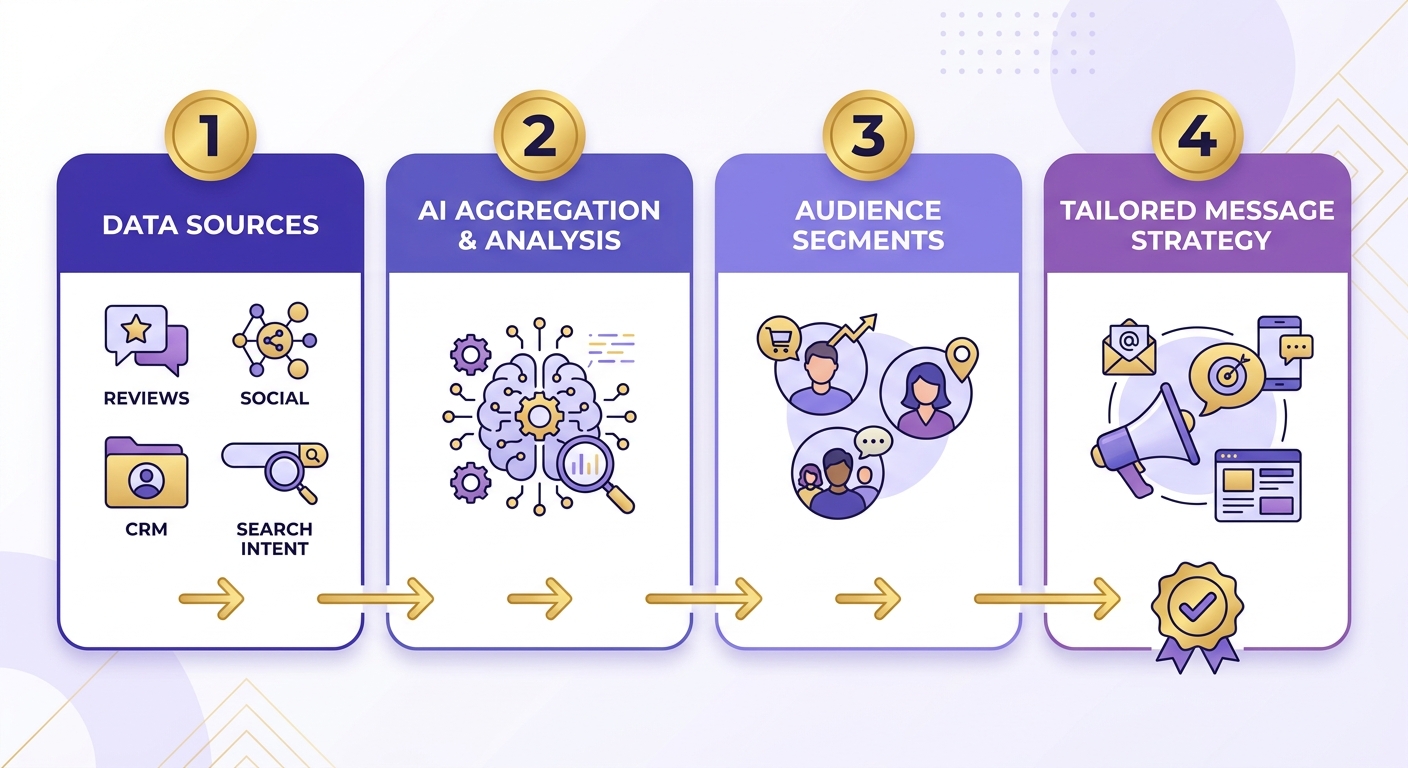
Turning Scattered Data Into Real Segments
Start by feeding AI the unstructured stuff you already own. Reviews, support tickets, comment threads, sales-call notes, and search queries hold the language your audience uses when nobody’s selling to them. AI clusters that into segments, surfaces recurring pain points, and flags intent signals you’d miss reading manually.
This is where AI earns its keep. It analyzes large volumes of data in real time, so you spot the effective angle without waiting for a post-campaign report. By reading behavioral patterns rather than demographic assumptions, it identifies what specific cohorts actually engage with.
Our practical move: don’t chase a single tool. Around 71% of marketers now run two or more chatbots, a sign that diverse toolkits beat single-platform reliance. Use one model to cluster language, another to pressure-test the segments.
What Makes Message Strategy Sharper for Premium Brands
Compare your audience’s language against your brand’s language, then close the gap. AI is good at showing where a hospitality or luxury lifestyle brand talks about “heritage” while its buyers talk about “quiet status.” That mismatch is the difference between a media pitch that lands an editorial feature and one that gets ignored.
Once you see the gap, refine positioning around the words the audience already uses. Feed those refined angles into pitch copy and feature narratives. The gains compound. Behavioral segmentation of this kind lifts engagement sharply, and teams applying AI across the full stack report over 2x sales growth. The angles that test best in research tend to outperform gut-driven positioning by a wide margin.
Where Humans Still Own the Call
On nuance, cultural sensitivity, and the data question. Algorithms can spot patterns, but they lack the cultural context to read them safely. A human has to judge whether a proposed message fits the brand’s heritage or risks alienating long-term customers through over-familiarity.
Our recommendation: prioritize editorial oversight. Every AI-generated insight gets vetted by a senior strategist who understands the subtle codes of your target market. That step keeps the brand from sounding generic or transactional.
AI for Personalization, Campaign Efficiency, and Faster Decision-Making
Why Speed Only Counts If the Brand Voice Holds
Faster output means nothing if it drifts off-brand. The ease of generating content makes holding a consistent, high-quality voice the primary challenge. For premium brands, a single misaligned campaign can dilute years of positioning.
Clear operational guidelines help. Our approach is simple: editorial teams keep complete ownership of the final narrative, so every published piece meets the brand’s standards for depth and authenticity.
A Practical AI Workflow for Building Tailored Visibility
A tailored visibility workflow for premium clients usually moves through stages that mirror the platform’s own onboarding: a consultation to understand client needs, angle generation, draft creation, fact-checking, brand review, and channel adaptation. AI can support parts of that process, but editorial teams own the judgment calls. That split is deliberate. It protects the brand from errors that could dent its standing.
Why the sequence matters operationally: real integration means moving past basic content generation toward structured workflows where automation handles the repetitive tasks. A defined, consultation-led process tells team members exactly when to use the tool and when to rely on manual expertise.
From News Hook to Published Feature
Start with the hook, then let AI compress the middle. Say a heritage watchmaker announces a limited release. AI pulls buyer sentiment from reviews, social comments, and search intent in hours, then drafts three pitch angles. An editor picks the sharpest one. That angle becomes the spine of a feature, a press release, and a set of shorter social cuts.
The time savings compound at the drafting stage. Research from McKinsey points to generative tools cutting content production cycles by up to 40 percent for teams that pair them with clear editorial guardrails. For a premium brand releasing several stories a quarter, that reclaimed time goes straight into deep research and relationship building.
The Quality-Control Steps That Protect a Premium Brand
Four gates, in order: source verification, claim checking, tone review, and legal or compliance review where the story touches pricing, provenance, or partnerships. AI drafts. Humans clear each gate. Nothing publishes with an unverified claim or an off-voice sentence.
Source verification is non-negotiable for premium features. If AI surfaces a stat, an editor traces it to origin before it runs. Tone review catches the drift that fast drafting introduces, keeping the final copy at the right level of sophistication.
Repurposing One Story Without Losing the Message
Lock one approved message architecture, then adapt it per channel. The core story stays fixed. Only format and length change. That’s how you scale visibility without fracturing the brand.
Here’s where a clear position on personalization matters. Standard digital marketing often prizes hyper-targeting across every platform, but premium brands do better with a more focused approach. Hold a consistent core narrative across select channels, and you preserve exclusivity while still expanding reach.
How to Measure AI’s Impact on Visibility, Editorial Coverage, and ROI
The honest measure of AI’s impact isn’t how much content it produced. It’s whether that content earned better placements, held your brand voice, and moved real business outcomes. For premium clients, the scoreboard has to track quality of visibility, not volume of output.
Here’s the trap most teams fall into. They measure what’s easy, not what matters. A BCG analysis of AI in marketing found only 15% of AI initiatives operate cross-functionally at scale to deliver real enterprise value. Everyone’s generating. Few are connecting that generation to the outcomes leadership actually cares about.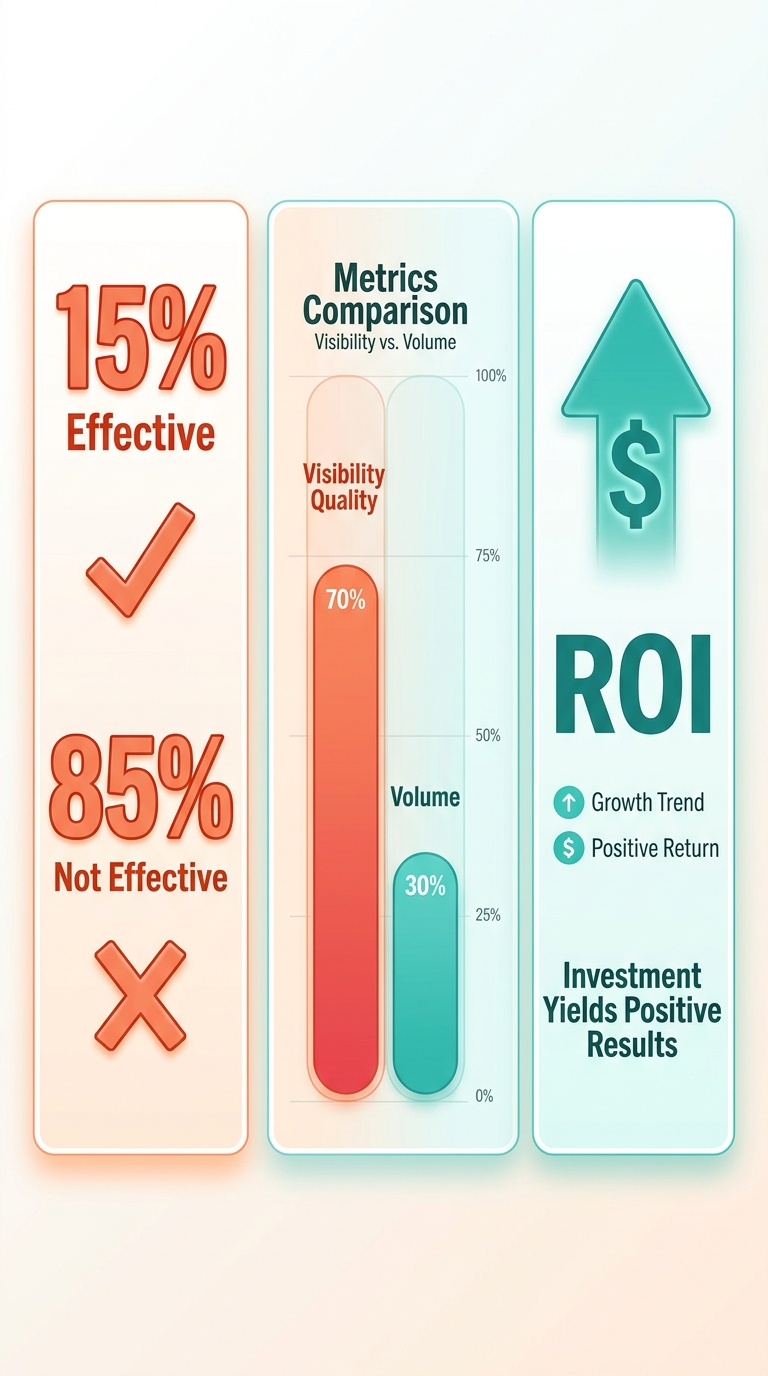
Which Visibility Metrics Actually Prove AI Is Earning Its Keep
The metrics worth tracking: qualified media mentions, pitch-to-placement rate, share of voice among direct competitors, engagement quality, and referral traffic from earned coverage. These tell you whether AI improved the quality of your visibility, not just the quantity of your activity.
Watch the gap between output and outcome. Output metrics count what you made: drafts written, pitches sent, posts published. Outcome metrics count what changed: placements landed, qualified traffic, revenue influenced. Confuse the two and you’ll celebrate a busy quarter that moved nothing.
Set a baseline before AI enters the workflow, then track the delta. Without a clean before-and-after on pitch-to-placement rate and share of voice, you can’t separate what AI moved from what the market did on its own. Run a control group of manually handled pitches alongside the AI-assisted ones, and you get the cleanest read on whether the tooling actually earns its place.
Judging Relevance and Personalization Quality
Relevance is measurable through conversion and engagement lift, not impressions. Track whether your AI-assisted targeting lifts response rates, reply quality, and journalist open rates, not just how many contacts you reached. A pitch that lands in the right inbox at the right moment beats a hundred that scatter.
Turnaround time belongs on the dashboard too. When AI compresses a research-and-draft cycle from weeks to days, log that against placement quality. Faster is only a win if the pitch still lands. Speed with no lift is just churn.
CMOs already expect the value to concentrate here. BCG’s survey shows leaders naming marketing effectiveness (57%) and personalization (45%) as the top ways AI will create value. Measure those two, and you’re measuring what your own peers say matters most.
Why Qualitative Judgment Still Decides the Score
Numbers don’t capture trust. For premium brands, editorial fit, tone accuracy, and brand perception carry as much weight as referral traffic. A feature that reads slightly off-voice can dent perception even while the traffic chart looks healthy.
Build a qualitative pass into every measurement cycle. Score placements on editorial quality and voice consistency, not just volume. The teams that win tie AI metrics back to leadership goals, then keep human eyes on tone and trust. Focus on long-term brand equity rather than short-term output metrics, and your technology investments actually support your positioning.
What Marketing Leaders Need to Do Next to Stay Credible
The next move for marketing leaders isn’t more AI. It’s guardrails. Before you scale AI across your workflow, define what your brand will and won’t say, what data you will and won’t use, and who signs off on anything the public sees. For premium brands, these rules are what protect the name.
Here’s the tension we keep running into. Generative AI thrives on data collection to sharpen personalization, but premium buyers value privacy and discretion. Aligning your data practices with what those buyers expect is what keeps trust intact in a highly automated market.
Why Set Brand Guardrails Before Scaling
Set the rules before the tools. Define approved facts, brand voice, and forbidden claims in writing, then run AI outputs through that filter. Draw those boundaries early and automated content stays aligned with the brand’s core values.
Build a reusable message framework and a source library. Every approved stat, positioning line, and proof point lives in one place. AI drafts against that library, not against the open internet. That’s how you keep a fast-moving process anchored to what’s actually true about the brand.
The trust research is blunt here. One consumer in the study put it plainly:
“I trust brands that are upfront about what data they collect and how they use it.”
That upfront posture is a competitive asset for premium names, not a compliance cost.
How to Keep Humans in the Loop
Every externally facing piece needs human sign-off. Press releases, executive commentary, and editorial features carry the most brand risk, so they get the most editorial scrutiny. AI can draft, test angles, and spin one story into versions for different outlets while holding the core narrative. Humans own proof, taste, and the trust signals that make a feature land.
Poorly governed automation carries real exposure, and legal teams increasingly flag AI-generated claims as a growing source of brand risk. A single unchecked statistic in a press release can undo months of credibility with an editor. When output gets cheap, the review step is what protects the name attached to it.
One caution worth naming: automation won’t resolve structural problems inside a marketing team. Get the operating framework solid before you scale the tools.
The Leadership Takeaway
The most effective teams use AI to sharpen tailored visibility, not to replace strategy, relationships, or trust. Most organizations still run AI in isolated pockets rather than as a coordinated function tied to brand outcomes. The focus stays on strategic alignment.
Set clear guardrails, keep strict editorial oversight, and you can use automation to strengthen your brand’s market presence without spending down the trust of your audience.
This article is intended for editorial and informational purposes only.
References
[1] AI for Marketing Leaders eBook (2024) – https://www.cmoalliance.com/ai-for-marketing-leaders-ebook/
[2] AI Will Shape the Future of Marketing – https://professional.dce.harvard.edu/blog/ai-will-shape-the-future-of-marketing/
[3] How to use AI in marketing: 15 examples to effective strategy … – https://www.imd.org/blog/marketing/ai-in-marketing/
[4] AI for Marketing Leaders Playbook – https://webflow.com/resources/ebooks/ai-for-marketing-leaders
[5] From Campaigns to Business Value: AI in Marketing – https://www.bcg.com/publications/2025/transforming-marketing-with-ai
[6] How marketing leaders are using AI today | Insights – https://www.heidrick.com/en/insights/data-analytics-artificial-intelligence/how-marketing-leaders-are-using-ai-today
[7] 2025 AI Trends for Marketers – https://offers.hubspot.com/ai-marketing
[8] Why AI Is Raising the Bar for Marketing Leadership – https://www.inc.com/shachar-scott/why-ai-is-raising-the-bar-for-marketing-leadership/91389420
[9] How AI is raising the bar for every marketing team – https://www.okoone.com/spark/industry-insights/how-ai-is-raising-the-bar-for-every-marketing-team/
[10] How Artificial Intelligence Is Raising The Bar On … – https://relationshipone.com/blog/artificial-intelligence-raising-bar-marketing/
[11] How UK-Based Marketing Leaders are Redefining Brand … – https://www.researchgate.net/publication/386338016_Navigating_Digital_Leadership_How_UK-Based_Marketing_Leaders_are_Redefining_Brand_Trust_in_an_AI-Driven_Era
[12] AI in Marketing Management: Executive Perspectives from … – https://www.researchgate.net/publication/388477312_AI_in_Marketing_Management_Executive_Perspectives_from_Companies
[13] (PDF) AI in Marketing Education: Capabilities required of … – https://www.researchgate.net/publication/390861437_AI_in_Marketing_Education_Capabilities_required_of_Marketers_today
[14] (PDF) AI-Driven Digital Marketing: How Artificial … – https://www.researchgate.net/publication/404255774_AI-Driven_Digital_Marketing_How_Artificial_Intelligence_is_Transforming_Marketing_Standards_Strategies_and_Consumer_Engagement
[15] Generative artificial intelligence in marketing and advertising – https://www.researchgate.net/publication/385885224_Generative_artificial_intelligence_in_marketing_and_advertising_Advancing_personalization_and_optimizing_consumer_engagement_strategies
Frequently Asked Questions
1. Can AI completely replace a PR agency for a luxury brand?
No. While AI can accelerate research and draft initial pitches, it cannot replicate the personal relationships that PR professionals build with journalists. Furthermore, crisis management and strategic positioning require human empathy and nuance that algorithms cannot provide.
2. How much data should a premium brand use for personalization?
Premium brands should prioritize transparency and user control over aggressive data collection. Focusing on contextual relevance—such as aligning messages with user intent and high-quality editorial environments—builds stronger long-term loyalty than tracking extensive personal history.
3. What happens if I add AI to a disjointed marketing team?
Introducing automation to a fragmented team typically accelerates operational issues. Without clear guidelines and unified processes, AI tools will simply produce inconsistent content faster. It is essential to define your workflows and brand standards before scaling technology.
4. Should I use AI for my final press release copy?
No. AI is highly effective for brainstorming angles and structuring drafts, but the final copy requires human editing. A professional writer must refine the tone, verify all facts, and ensure the narrative aligns perfectly with the brand’s voice before distribution.
5. Is the biggest AI challenge finding talent or getting my team to use it?
The primary challenge is driving adoption and providing proper training for your existing team. While finding specialized talent is important, the immediate value comes from upskilling current staff so they can integrate these tools into their daily workflows effectively.
6. Why do so few AI marketing initiatives deliver real business value?
Many organizations focus on vanity metrics like content volume rather than strategic outcomes. To drive real value, AI initiatives must be integrated across departments and measured against business goals like qualified lead generation and brand equity.
7. How should I use generic content tools versus a hybrid workflow?
Generic tools are best suited for low-risk tasks like summarizing long documents or formatting text. For high-impact campaigns, a hybrid approach is necessary: use AI to gather data and generate initial drafts, then have strategists and editors refine the content to ensure it meets quality standards.