By Chris Caprice
Key Takeaways
Miami nightlife in 2026 is no longer defined by one type of club.
The city still has the celebrity-driven megaclubs that made Miami internationally famous, but they’re now sharing the market with marathon electronic-music institutions, underground warehouses, hi-fi listening rooms, intimate dance floors and venues that blur the line between nightlife, performance and hospitality.
That variety is what makes Miami interesting right now.
The question isn’t simply “What’s the best club in Miami?”
It’s “What kind of night are you looking for?”
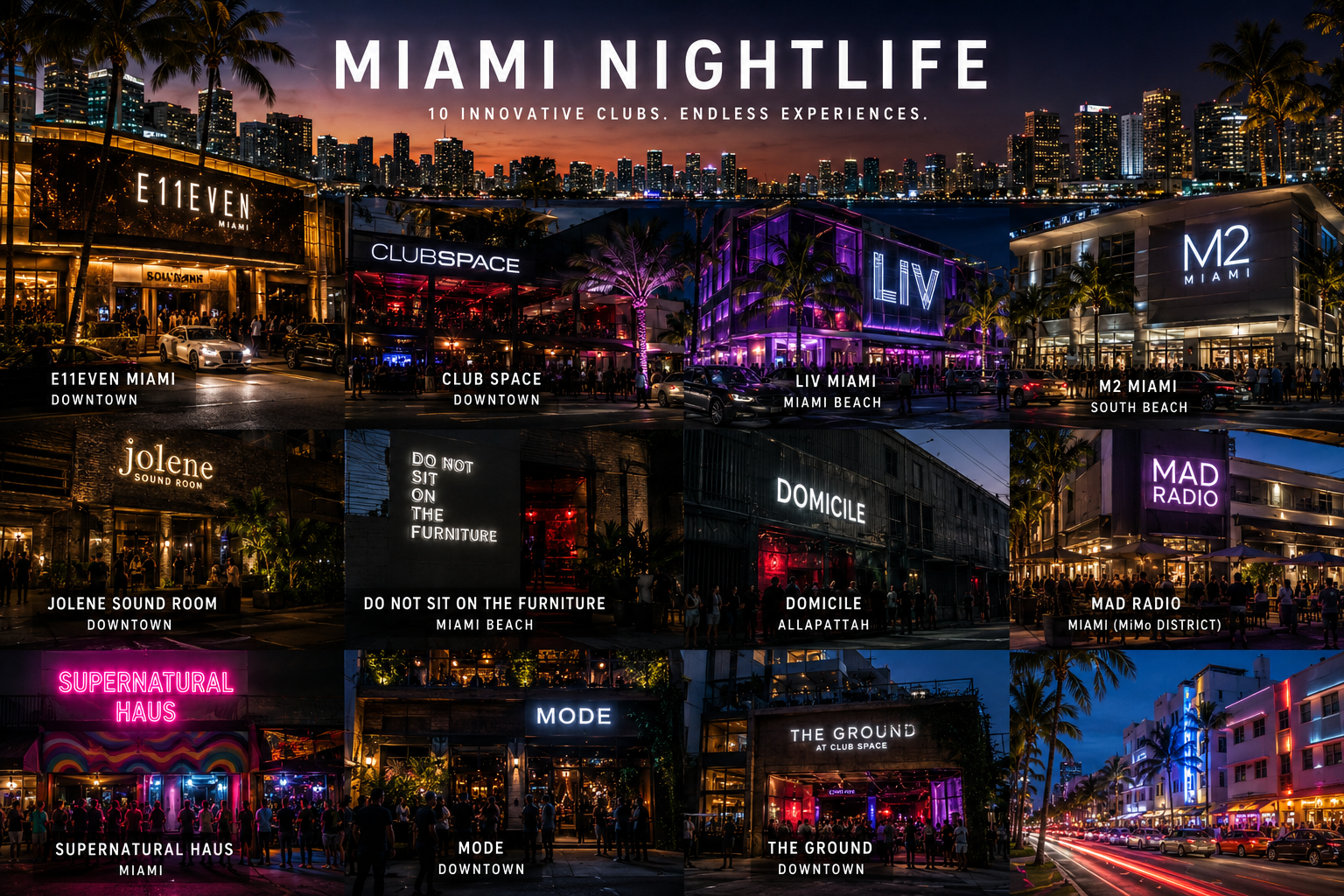
Here are 10 Miami nightlife destinations that demonstrate how the city’s after-dark experience continues to evolve.
1. E11EVEN Miami — Downtown Miami
There are nightclubs, and then there is E11EVEN Miami.
The Downtown Miami venue describes itself as an ultraclub, and the distinction makes sense. E11EVEN combines nightclub production, live entertainment, aerial performers, dancers, celebrity appearances and a center-stage format inside an environment designed to keep moving long after conventional nightlife hours end.
Its around-the-clock model remains one of its defining characteristics. Time Out’s 2026 Miami club guide describes E11EVEN as a 24-hour operation with aerialists, acrobats and a central performance stage.
But what makes E11EVEN particularly interesting in 2026 is how far the concept has expanded beyond simply being a club.
During the 2026 FIFA World Cup, the venue transformed into a viewing destination, using massive 30-foot screens and surround sound for matches before transitioning back into its nightlife programming.
The brand has also expanded into areas including hospitality and residences, demonstrating how a successful nightlife identity can become a broader lifestyle platform. Its official site currently promotes E11EVEN Residences alongside the club and its other brand extensions.
What makes it innovative: It treats nightlife as entertainment infrastructure rather than simply a dance floor.
Best for: Big celebrations, celebrity-driven nights and visitors who want the full Miami spectacle.
E11EVEN Miami official website
2. Club Space — Downtown Miami
If E11EVEN represents spectacle, Club Space represents endurance.
For more than 25 years, Space has helped define Miami’s electronic-music identity. Its famous Terrace has become particularly associated with marathon parties that continue through sunrise and well into the day.
The transparent retractable roof plays a major role in that experience.
Instead of hiding guests from the fact that morning has arrived, Space makes sunrise part of the party.
That sounds like a small architectural detail, but it changes the entire relationship between the room, the crowd and time.
Space also demonstrates how a nightclub can become a cultural ecosystem. The building incorporates rotating work from local artists, while The Ground downstairs operates as a roughly 550-capacity venue capable of hosting live bands, label showcases, hip-hop, drum and bass and programming outside the Terrace’s core electronic identity.
What makes it innovative: Space turned the after-hours party itself into a recognizable Miami cultural experience.
Best for: Electronic-music fans and anyone who believes sunrise should not automatically mean the night is over.
3. LIV Miami — Fontainebleau Miami Beach
Some nightlife concepts are built around underground credibility.
LIV Miami goes in the opposite direction.
Located inside Fontainebleau Miami Beach, LIV has built its identity around large-scale production, celebrity culture, major DJs and performers, VIP hospitality and the unmistakable energy of a Miami Beach megaclub.
The venue remains active with major 2026 bookings. Current listings include artists such as Disco Lines, Korolova and Steve Aoki.
What makes LIV relevant after so many years isn’t simply that famous people go there.
It’s the way the venue has consistently packaged music + luxury hospitality + celebrity + production into one recognizable product.
In a nightlife industry where venues can disappear quickly, longevity itself becomes a form of innovation.
What makes it innovative: LIV helped establish the modern luxury-megaclub formula that connects nightlife directly to a major resort experience.
Best for: VIP nights, celebrations, major DJ performances and visitors looking for the polished Miami Beach club experience.
4. M2 Miami — South Beach
The building housing M2 Miami has lived several nightlife lives.
The historic Miami Beach venue was once a theater and later became home to famous club concepts including Mansion. Today, M2 has been reimagined as a large-scale electronic-music destination associated with Ultra Worldwide.
That combination of historic architecture and modern production makes it especially interesting.
Time Out highlights the approximately 35,000-square-foot space and its elaborate central lighting system, while Miami’s official tourism guide continues to identify M2 as one of the city’s major EDM nightlife destinations.
It’s a good example of Miami nightlife recycling its own history.
Instead of demolishing the past to create something modern, M2 puts contemporary technology and electronic music inside a building with decades of entertainment history.
What makes it innovative: It combines Miami Beach nightlife history with festival-scale electronic production.
Best for: EDM fans, large events and anyone who wants a massive South Beach dance-floor experience.
5. Jolene Sound Room — Downtown Miami
Then Miami nightlife suddenly gets smaller.
Located beneath the historic Julia & Henry’s building in Downtown Miami, Jolene Sound Room is an intimate basement club inspired by midcentury recording studios and 1970s leisure culture.
Instead of trying to compete with Miami’s largest clubs on size, Jolene competes on sound, music curation and atmosphere.
Time Out describes the venue as a cozy downtown discotheque focused on underground disco and house, with synchronized ceiling lights contributing to its retro identity.
That represents one of the most important shifts happening in Miami nightlife.
Not every customer wants the biggest room anymore.
For some guests, a smaller dance floor, serious sound system and carefully selected DJ can feel more premium than another giant VIP section.
What makes it innovative: Jolene makes intimacy and sound quality the luxury product.
Best for: House and disco fans, music-first crowds and people who want something more intimate than a megaclub.
6. Do Not Sit On The Furniture — Miami Beach
Even the name tells you this isn’t trying to be a conventional South Beach club.
Do Not Sit On The Furniture has built a reputation around intimate electronic-music experiences rather than massive bottle-service production.
Founded by DJ-producer Behrouz and Megan Nazari, the venue focuses heavily on underground house and electronic programming. Time Out’s current 2026 guide highlights its compact dance floor, outdoor patio and bookings connected to labels and sounds including Anjunadeep, Crosstown Rebels and All Day I Dream.
Its significance comes from proving that Miami Beach nightlife doesn’t have to mean megaclub.
A small room with the right DJ, sound and crowd can create its own gravitational pull.
What makes it innovative: It offers an underground counterpoint to South Beach’s traditional VIP-club formula.
Best for: Deep-house fans and people who care more about who’s behind the decks than who’s sitting at the biggest table.
7. Domicile — Allapattah
If some Miami clubs are designed to look luxurious, Domicile isn’t particularly interested in that conversation.
That’s the point.
The underground venue has developed around harder techno and warehouse culture. Time Out’s updated 2026 nightlife coverage notes that Domicile relocated to Allapattah and now features a stripped-down black-walled environment with synchronized strobes and programming that can include international techno and trance artists alongside Miami talent.
There’s no need to imitate the velvet-rope model when the audience is deliberately searching for the opposite.
Domicile demonstrates that nightlife innovation can come from removing things rather than adding them.
Less bottle-service theater.
Less celebrity obsession.
More emphasis on music, sound and the dance floor.
What makes it innovative: Domicile brings a raw warehouse-rave philosophy into Miami’s increasingly polished nightlife market.
Best for: Serious techno fans and people looking for underground energy rather than traditional Miami glamour.
8. MAD Radio — MiMo District
MAD Radio may be one of the clearest examples of where nightlife is heading next.
The concept isn’t simply a nightclub.
It’s part café, part radio station, part music community and part late-night venue.
Located inside a midcentury-era motel along Biscayne Boulevard, MAD Radio operates during the day as a café and social space before shifting at night toward DJs, dancing and underground music. It also broadcasts DJ performances through its digital platform, allowing what happens inside a relatively intimate Miami venue to reach listeners outside the room.
That hybrid model is important.
Nightlife venues traditionally make most of their value during a narrow window late at night.
MAD Radio creates reasons for people to interact with the brand during the day, at night and digitally.
What makes it innovative: It combines hospitality, nightlife, broadcasting and music culture under one identity.
Best for: Vinyl lovers, house and disco fans and people who prefer music culture over velvet-rope culture.
9. Supernatural Haus — Miami
Nightlife isn’t only about production.
It can also be about community.
Supernatural Haus has become a creative nightlife space with particularly strong connections to Miami’s LGBTQ+ community.
Its programming stretches beyond conventional club nights into drag performances, cabaret, karaoke, open-mic programming, K-pop nights, DJs and after-hours events. Time Out added the venue to its updated 2026 list of Miami clubs, highlighting both the diversity of its programming and its membership options.
That model matters because nightlife venues increasingly have to create communities rather than simply crowds.
A crowd shows up for one headliner.
A community comes back because the venue feels like theirs.
What makes it innovative: Supernatural Haus treats nightlife as a community and creative platform rather than simply a weekend transaction.
Best for: Creative crowds, LGBTQ+ nightlife and guests looking for programming beyond the standard DJ-and-bottle-service formula.
10. MODE — Downtown Miami
MODE represents another piece of Downtown Miami’s increasingly diverse late-night ecosystem.
The intimate two-story venue combines an underground dance floor downstairs with a more relaxed cocktail-oriented environment upstairs.
Programming can move across Afro-house, Detroit-influenced techno and other electronic sounds, while the venue also hosts occasional comedy and jazz programming.
That flexibility is part of what makes MODE interesting.
A nightlife venue no longer necessarily needs one identity every night of the week.
A room can function differently depending on who’s performing and who’s walking through the door.
What makes it innovative: MODE combines underground club culture with a flexible multi-format entertainment model.
Best for: Downtown nightlife explorers and guests who want both dancing and somewhere to step away from the dance floor.
What Miami Nightlife Looks Like in 2026
Put these ten venues together and you can see where Miami nightlife is going.
At one end, E11EVEN, LIV and M2 continue pushing large-scale production, entertainment and VIP hospitality.
Club Space continues proving that music and marathon programming can become an institution.
Then venues such as Jolene, Do Not Sit, Domicile and MODE are making the opposite argument: smaller rooms, stronger identities and music-first crowds can be just as compelling.
MAD Radio expands nightlife into daytime hospitality and digital broadcasting.
And Supernatural Haus demonstrates how community itself can become the foundation of a nightlife brand.
That’s why the word innovative matters here.
Innovation isn’t necessarily a larger LED wall or another expensive bottle presentation.
Sometimes innovation means understanding exactly why people want to gather and designing the experience around that reason.
Miami currently has room for all of it.
From the Megaclub to the Microclub
For years, Miami’s nightlife image was dominated by South Beach megaclubs.
That’s changing.
Time Out’s January 2026 assessment of the local scene specifically points to a growing group of smaller, more intentional lounges emphasizing hi-fi sound systems and curated programming alongside the city’s established large clubs.
Downtown Miami has also become particularly important to that evolution.
Club Space, E11EVEN, Jolene and MODE provide dramatically different experiences within the broader downtown nightlife ecosystem.
Meanwhile, South Beach and Mid-Beach remain home to major destinations including LIV, M2 and Do Not Sit On The Furniture.
The result isn’t one Miami nightlife district replacing another.
It’s more choices for more kinds of people.
Music Is Becoming the Differentiator Again
For all the technology going into modern nightlife, one of the most interesting trends is remarkably simple.
Music matters again.
Hi-fi rooms, underground techno venues, carefully curated house lineups and marathon electronic sets all place the DJ and sound system back at the center of the experience.
That’s significant in a city where nightlife has sometimes been associated more with tables and celebrity sightings than the actual music.
The strongest venues understand that the two don’t have to compete.
LIV can deliver celebrity spectacle.
Space can deliver sunrise.
Jolene can deliver intimacy.
Domicile can deliver raw techno.
E11EVEN can deliver theatrical entertainment.
A strong nightlife city needs all of them.
Frequently Asked Questions
What are the best nightclubs in Miami in 2026?
There isn’t one best club for every visitor. Club Space is one of Miami’s defining electronic-music destinations, while E11EVEN is known for its around-the-clock ultraclub experience. LIV offers the classic luxury Miami Beach megaclub environment, and venues such as Jolene and Domicile cater to more intimate or underground music audiences. Time Out’s January 2026 guide ranks Club Space, E11EVEN and M2 among the city’s leading clubs.
What are the biggest Miami clubs for VIP nightlife?
LIV and E11EVEN remain two of the city’s most prominent choices for large-scale VIP nightlife. M2 also offers a large-format South Beach club experience. Miami’s official tourism guide currently identifies all three among the city’s notable nightlife destinations.
Where should electronic-music fans go in Miami?
Club Space is a major destination for house and electronic music, while Do Not Sit On The Furniture offers a more intimate experience. Domicile focuses heavily on harder techno and underground sounds, and Jolene Sound Room emphasizes house and disco in a smaller hi-fi environment.
Is Miami nightlife only in South Beach?
No. Downtown Miami has become one of the city’s most important nightlife districts, with venues including Club Space, E11EVEN, Jolene and MODE. Allapattah and other neighborhoods are also contributing to Miami’s underground nightlife scene.
Do Miami clubs require tickets?
Many major clubs sell advance tickets for individual events. Greater Miami’s official tourism guide recommends purchasing tickets when available for venues including LIV, Club Space, E11EVEN and M2, particularly when major DJs or performers are scheduled.
What should I know before going out in Miami?
Dress codes, age requirements, ticket-entry windows and table policies vary significantly by venue and event. Check the venue’s current event information before going, particularly because Miami nightlife programming changes frequently.
Industry Idols
Industry Idols covers the people and businesses shaping hospitality, nightlife, entertainment, fashion and culture in Miami and beyond.
Miami nightlife isn’t built by buildings alone. It’s built by promoters, DJs, hospitality teams, performers, designers, owners and entrepreneurs who understand how to turn a room into an experience.
Those are the people—and the stories—Industry Idols is here to cover.
You don’t inherit the spotlight. You earn it.
References & Further Reading
- Time Out Miami — Best Clubs in Miami 2026 — Updated January 2026 guide covering Club Space, E11EVEN, M2, Do Not Sit On The Furniture, Jolene, Domicile, MAD Radio, Supernatural Haus, MODE and other current venues.
- Greater Miami & Miami Beach — Miami Clubs 101 — April 2026 guide to current Miami nightlife, tickets, VIP access and major venues.
- Greater Miami & Miami Beach — Best Dance Clubs in Miami — Official destination coverage of Miami’s club scene and established nightlife destinations.
- Time Out — Club Space — Updated January 2026 coverage of Space, its Terrace, sound system, marathon parties and local art.
- Time Out — MAD Radio Miami — Coverage of MAD Radio’s café, radio, nightlife and music-community concept.
- Greater Miami & Miami Beach — LIV Miami — Current LIV listing and 2026 event programming.
- Greater Miami & Miami Beach — Jolene Sound Room — Current venue information and 2026 programming for the Downtown Miami sound room.
Nightclub schedules, admission policies, age requirements, performers and operating hours can change. Check directly with each venue before visiting.