
From South Beach restaurants to neighborhood favorites, service charges have become part of the Miami dining experience. But tipping fatigue, changing tax rules and confusion over where the money actually goes are putting the practice under a new spotlight.
By Chris Caprice | Industry Idols
In Miami, the final few minutes of dinner can sometimes generate almost as much conversation as the meal itself.
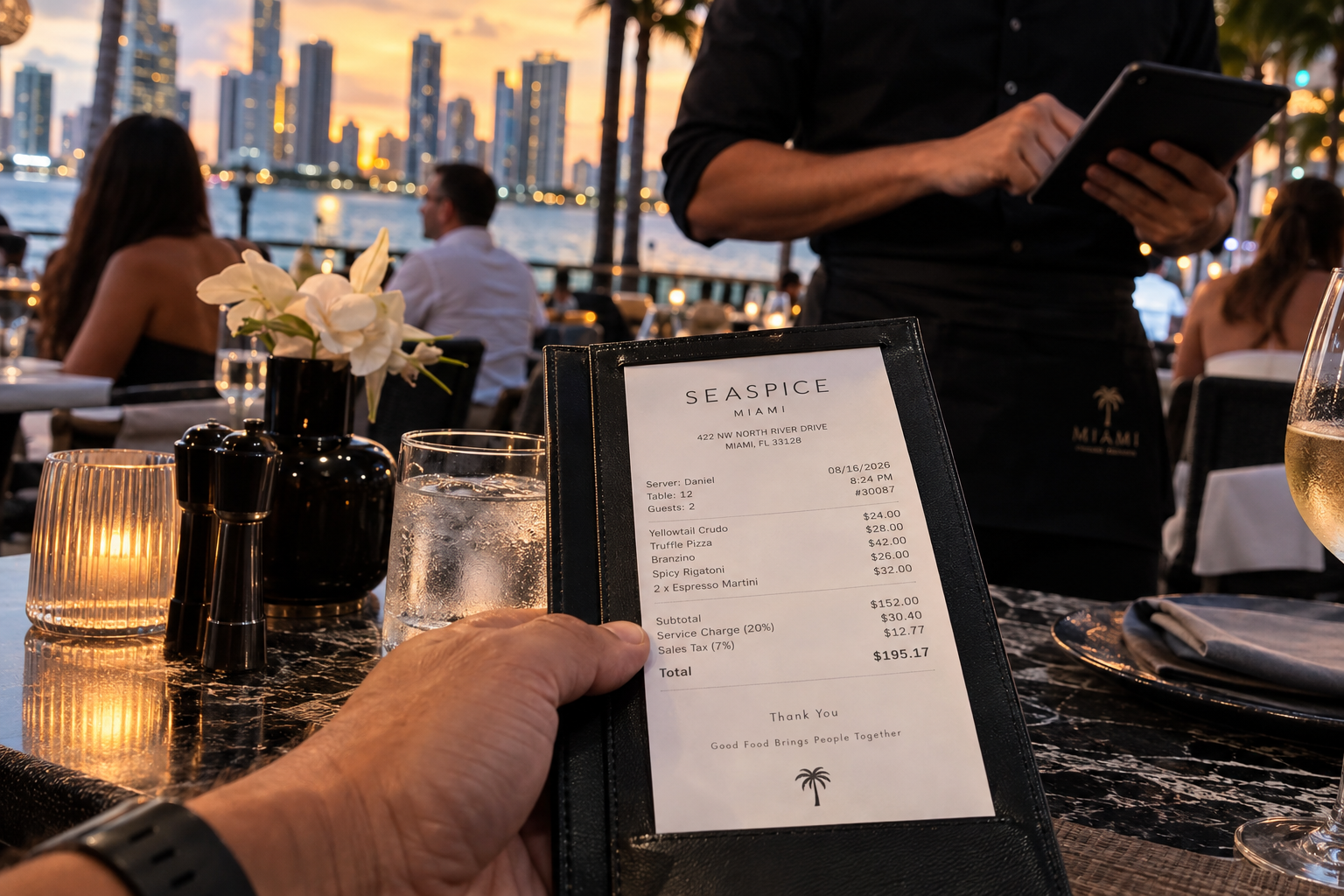
The check arrives. There is the food, the drinks and the tax. Then comes another line: 18%, 20%, sometimes more.
Service charge. Automatic gratuity. Suggested tip. Additional gratuity.
For diners, those terms can blur together. But they do not necessarily mean the same thing.
And in a city where hospitality is part of the culture, the difference matters.
A Service Charge Is Not Necessarily a Tip
This is probably the biggest source of confusion.
According to the IRS, a mandatory service charge automatically added to a customer’s bill is not considered a tip for federal tax purposes.
A true tip is voluntary. The customer decides whether to leave it and how much to give.
A mandatory service charge works differently. The restaurant requires the customer to pay it. If that money is later distributed to employees, it is generally treated as wages rather than tips.
To a diner looking at a receipt, an 18% service charge may look almost identical to an 18% tip. Legally and financially, however, they can be very different.
Where Does the Money Actually Go?
That’s the question many diners really want answered.
Seeing a 20% service charge on a check does not automatically tell you how that money is distributed.
A restaurant may use the charge to compensate servers, bartenders, bussers or other employees. Different establishments may structure their charges differently.
That makes transparency important.
If a restaurant adds a mandatory charge, diners should be able to understand what it represents before deciding whether to leave anything additional.
“No Tax on Tips” Adds Another Layer
The federal qualified-tips deduction has made the distinction between tips and service charges even more important.
Despite the popular “No Tax on Tips” name, the provision does not simply make every dollar connected to tipping tax-free.
Eligible workers may deduct qualified tips subject to federal requirements. One of the important distinctions is that qualifying tips are voluntary.
A mandatory service charge that a customer cannot reject or change is not treated the same way.
That means the wording at the bottom of a restaurant bill can have consequences beyond the customer’s final total.
Miami Was Already Talking About Tipping Fatigue
The debate did not begin with federal tax changes.
Digital checkout screens have expanded tipping into more parts of everyday life. Customers now encounter suggested gratuities at restaurants, coffee counters, takeout windows and businesses where tipping may not have traditionally been expected.
A 2024 Miami Herald report, citing Toast data, placed Florida near the bottom nationally for average tipping at the time.
For hospitality workers, inconsistent tipping can mean unpredictable income.
For customers, increasingly frequent tip prompts can create a different problem: tipping fatigue.
Eventually, diners start asking a simple question:
What exactly am I tipping for?
Miami Makes the Conversation Different
Miami serves locals, domestic tourists and international visitors, all of whom can arrive with very different expectations about tipping.
Someone accustomed to American restaurant culture may consider a 20% tip normal.
An international visitor from a country where service is commonly included may approach the same bill completely differently.
Then there are restaurants where a service charge is already included and the receipt still provides another line for an additional gratuity.
That doesn’t necessarily mean anything improper is happening.
But it makes clarity essential.
If 18% or 20% has already been added, guests should be able to understand what that charge represents before being asked whether they want to leave more.
Automatic Charges Solve a Real Problem, Too
There is another side to the debate.
Hospitality workers can experience significant swings in income. A packed Saturday night may look completely different from a slow Tuesday.
Automatic service charges can provide restaurants with a more predictable way to compensate employees and reduce some of the uncertainty associated with voluntary tipping.
For restaurants serving large groups or visitors unfamiliar with American tipping customs, that predictability can be valuable.
So the conversation isn’t simply about whether automatic service charges are good or bad.
It’s about whether everyone understands the system.
The Three Systems Diners Usually Encounter
Miami diners generally see some variation of three approaches.
Mandatory service charge: A percentage is automatically added to the check.
Suggested tip: The restaurant presents suggested percentages, but the customer remains free to choose another amount or leave nothing.
Traditional tip: The customer determines whether and how much to leave.
Those differences matter.
A suggested 20% button isn’t necessarily the same as a mandatory 20% charge. If the customer genuinely controls the amount, the payment can remain a voluntary tip.
The Real Issue Is Transparency
Most diners aren’t interested in becoming experts on restaurant payroll.
They shouldn’t have to be.
They want to enjoy dinner.
Servers want to be compensated fairly.
Restaurants need a system that allows them to attract and retain good employees while keeping their businesses sustainable.
Those goals don’t have to conflict.
The friction begins when customers don’t understand the bill.
If a restaurant adds a service charge, it should be clearly disclosed.
If an additional tip is optional, that should be obvious.
And diners should take a moment to read the receipt before automatically selecting another percentage.
The Check Is Part of the Experience
Miami restaurants compete on food, atmosphere, design, music, service and location.
Increasingly, they’re also being judged on how the night ends.
A spectacular dinner followed by a confusing bill can change the final impression of an otherwise excellent experience.
That may be the bigger story behind Miami’s tipping debate.
It’s not simply about whether tipping should disappear or whether every restaurant should use automatic gratuity.
It’s about trust.
Guests want to know what they’re paying.
Workers want to know how they’re being compensated.
Restaurants want a system that works for both.
The establishments that communicate those answers clearly may ultimately have the advantage.
Because in Miami, the final impression of dinner can sometimes come down to one small line at the bottom of the check:
Service charge included.
The question is whether everyone at the table understands what that actually means.
This article is intended for editorial and informational purposes only and does not constitute legal or tax advice.